
Our apologies for the cheesy headline, but we have this wonderful word in the futures industry – Contango – and we just so happened to come across a nice piece on McClellan Financial covering Crude Oil’s move away from Contango into Backwardation, giving us a chance to talk Contango…
First, what is Contango:
When the near month contract is priced lower than the out months, that condition is known as “contango”. In commodities like gold and silver, contango is the norm since the available supply consists of not just the mining production but also all of the bullion sitting in warehouses and safes around the world.
But because oil is so much more expensive to store than gold is, there is not the same sort of standing inventory available to remediate temporary supply-demand disruptions. So oil prices can move to very large conditions of contango, or to the opposite condition known as “backwardation” like we are seeing right now.
The normal market-based remedy for a large contango condition is for speculators to buy the cheaper commodity in the spot market and put it into storage, then sell a distant month futures contract to take advantage of the price difference between near month and out month pricing. That can be a profitable game if the amount of that price spread is sufficient to pay for both the storage costs and the cost of capital. So there is a natural limit to how big a contango can get, assuming that there are storage facilities available.
But the thing which is catching McLellan’s eye isn’t Contango in Crude, it is the highest level of Backwardation (reverse Contango, if you will) in more than 15 years, reversing the major Contango conditions which persisted for most of the post financial crisis period (2009 to 2011):
“The near month futures contract for light sweet crude oil right now is the August 2013 contract, which settled on July 18 at $108.22 per barrel. But looking out 11 months into the future to the July 2014 contract, we find that it closed at just $95.56. That is a huge difference, and it says that oil futures traders are not willing to bet on the current month’s high price continuing into the future. In other words, it is a temporary anomaly.”
“This current spread between the August 2013 and July 2014 contracts is the biggest raw price spread in years, although as a percentage of the current price we have seen more severe backwardation at other times.”
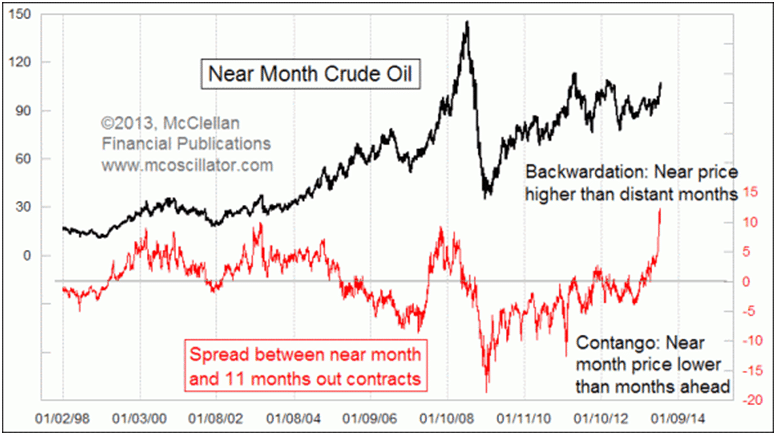
Chart Courtesy: McClellan Financial Publications
(Disclaimer: past performance is not necessarily indicative to future results.)
This spike higher in the spread between front and back month contracts in Crude Oil is causing difficulties for many of the spread trading CTAs we follow, but those traders are also saying this is a dramatic spike in the front months which can’t last for much longer. McClellan’s piece agrees on this front, saying [emphasis ours]:
The way that a backwardation condition gets resolved is either for consumers to use less of the high priced commodity now, or for producers to accelerated production to meet the higher current spot price rather than saving that production for later when prices are not as attractive There are limits on how quickly such production increases can be implemented, but a $12/barrel difference between the current price and that of 11 months out can pay for a lot of improvements to production capacity. There are also limitations on how much demand can be reduced due to higher prices. People still have to drive to work, and they still want to take the Winnebago to Yellowstone.
This current spread between the August 2013 and July 2014 contracts is the biggest raw price spread in years, although as a percentage of the current price we have seen more severe backwardation at other times. The message to take from this is that the current pop in near month futures prices is not likely to continue much farther, with the rubber band already stretched.”
One item not included in the piece is the structural anomalies surrounding Cushing, Oklahoma and all of the problems getting the shale oil production out of the middle of the US. The following chart shows that we’re well on our way to fixing that problem, with the amount of oil being sent down to the Gulf Coast from Cushing set to triple by this time next year. That is likely keeping a lid on further out Oil contracts as well.
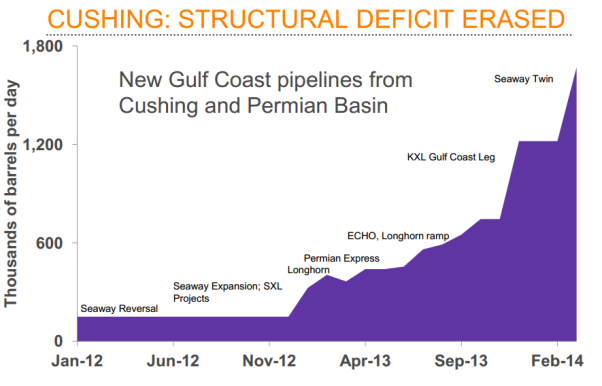
Chart Courtesy: Reuters
(Disclaimer: Past performance is not necessarily indicative to future results.)
What’s it all mean for managed futures? Well, one well known Crude oil spread trader sure wants to see that Backwardation spike reverse course to the benefit of his short Oil spreads. After that, your run of the mill CTA doing trend following might be overpaying in the front month contract if he’s looking for a several month’s long trend upwards. This costs them some profitability if Crude continues to rise, and causes larger than expected losses should the up trend stall out and the backwardation spike revert to the mean some.
We’ll let the energy specialists figure all this out for now.