
A piece in the current issue of the Journal of Financial Planning entitled “Investigating Alternative Investments” does a great job of taking a look at the many complex facets an investment adviser should be considering as they guide their clients through the investing process. One chart in particular, however, stood out to us:
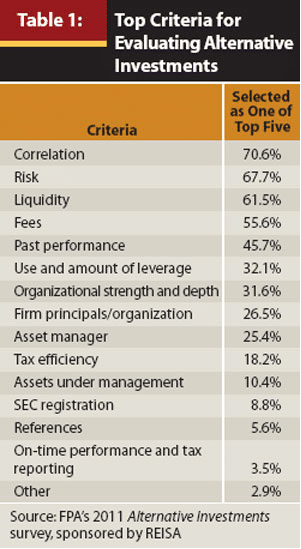
These are all important issues, to be sure, but what kills us looking at a table like this is that managed futures isn’t even on the radar of many investment advisers. We’re talking about an asset class that has been historically non-correlated to traditional asset classes, employs some of the most stringent risk management techniques in finance, has daily liquidity, reports performance net of fees, has a history of strong crisis performance, has outperformed the stock market over the long run, allows individuals to choose their own leverage levels, has unique tax benefits associated with returns, and is regulated by the CFTC and NFA with requirements that are often much stricter than what the SEC imposes. Past performance is not necessarily indicative of future results, regulations are no guarantee in this asset class or any other, and the risks involved in futures means that the investment may not be suitable for everyone, but given how closely the various attributes of a managed futures investment align with the interests of advisers, wouldn’t you think advisers would consider the asset class more frequently?