
Yesterday morning the Twitterverse was abuzz over biotech stock Rosetta Genomics (ROSG) after it leaped 74% from its opening price of $13.45 to a high of $23.43 in less than two hours. At times like this that we like to remind ourselves of two things: first, that dramatic moves in markets can just as easily bring ruin as riches (remember Long-Term Capital Management, Amaranth Advisors, etc), and second, that market returns are not normally distributed.
This doesn’t just apply to small biotech firms, either – even the returns of big indices like the S&P 500 aren’t normally distributed. To show you what we mean, we charted the distribution of daily changes in the S&P 500, and overlaid it with an equivalent number of randomly-generated returns along a standard normal distribution to show what it might look like if returns were normally distributed:
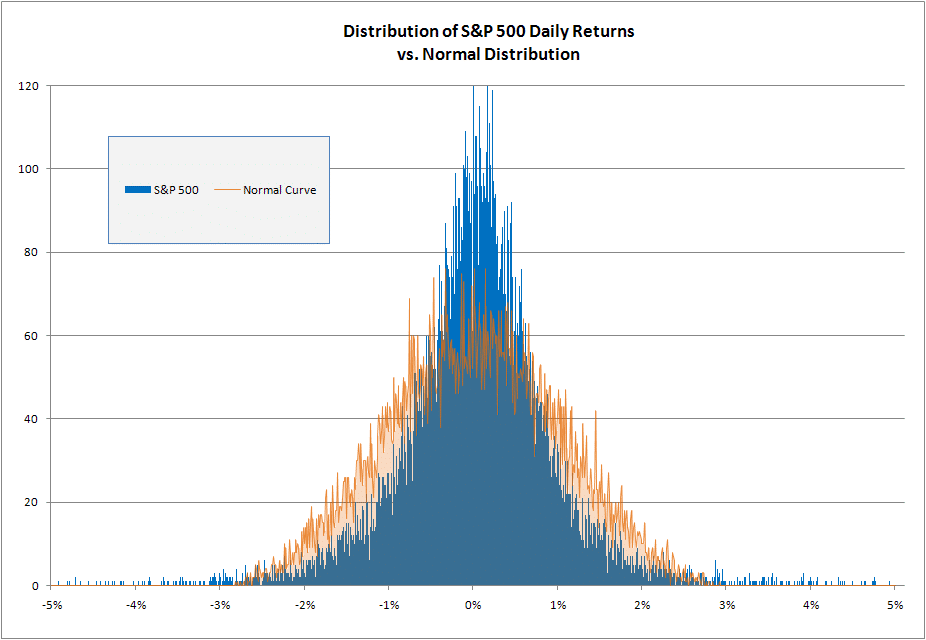
There are a couple of things of note here: first, the S&P 500 returns are far more clustered around the mean than in our normal distribution. In other words, more days are clustered close to 0% (so much so that we cut off the bar for the 0% days – it went all the way up to 169). In fact, there are actually fewer days in the 1%-2% range than we would expect if returns were normally distributed. More importantly, see all those data points scattered off to the sides? Yeah, we know they are small and hard to see, but they are there – those little blue bumps along the bottom axis are what we call outliers. A normal distribution should have virtually zero (0.3%) of its data points fall beyond 3 standard distributions of the mean, thus the flat orange line on either side of the graph; but for the S&P 500 it’s almost three times higher – about 1.4%.
Why does all this matter? Well, sometimes big financial institutions use probability to determine their risk (like JPMorgan’s use of Value at Risk, a measure of risk that tries to determine the likelihood that the trading loss of a given period will exceed a certain level). When financial risk calculations start relying too heavily on these kinds of statistical assumptions, those little blue outlying bumps can turn into billions worth of losses – or worse.
Oh, and by the way, we had to cut off the chart at +/-5% to make it readable, even though doing so cut off 41 data points (that’s right, there’ve been 41 days in which the daily gain or loss in the S&P 500 was larger than +/-5%). As always, we must tip our hat to Nassim Taleb and his book Black Swan, which delves into this subject in much greater detail (and is a must-read in our opinion). Remember that finance lies in Extremistan, where it pays to expect the unexpected.