
You know you’re supposed to be diversified in your investments, and that’s just as true for CTAs as it is for any other investor. That’s why CTAs try to trade in futures markets that are non-correlated; it can help reduce risk and volatility. Unfortunately, when the markets move up or down in unison, achieving diversification is much more difficult, and that’s why we’ve started keeping an eye on two statistics that illustrate how easy or difficult it has been to stay diversified in the futures markets: the risk on/risk off trade, and the market correlations.
First, let’s look at how the risk on/risk off trade fared in May. (If you need a refresher, we broke down the risk on/risk off trade earlier this year.) Obviously, May was a down month for commodities (and another reminder of why “buy and hold” long-only commodity investments are a bad idea). The average daily % change across our grouping of “risk on” markets was -0.47% for May, compared to an average of 0.08% during the first 4 months of the year. In the midst of the sell-off, there were 6 risk off days, raising the 2012 total to 14, or 13.6% of trading days this year.
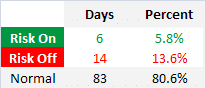
Risk On = average gain of over 1% for ‘risk’ assets; Risk Off = average loss of over -1% for ‘risk’ assets
Unless you spent May in a cave, that probably isn’t too surprising. So how about the overall correlation? As a refresher, correlation is a statistical measure of how interrelated two sets of data are. A correlation of 1.00 would mean that the markets move in lock-step, and a correlation of -1.00 means that they always move in opposite directions. What we’re looking for is non-correlation (a correlation of 0.00), which would mean that the two are behaving as though they are completely unrelated.
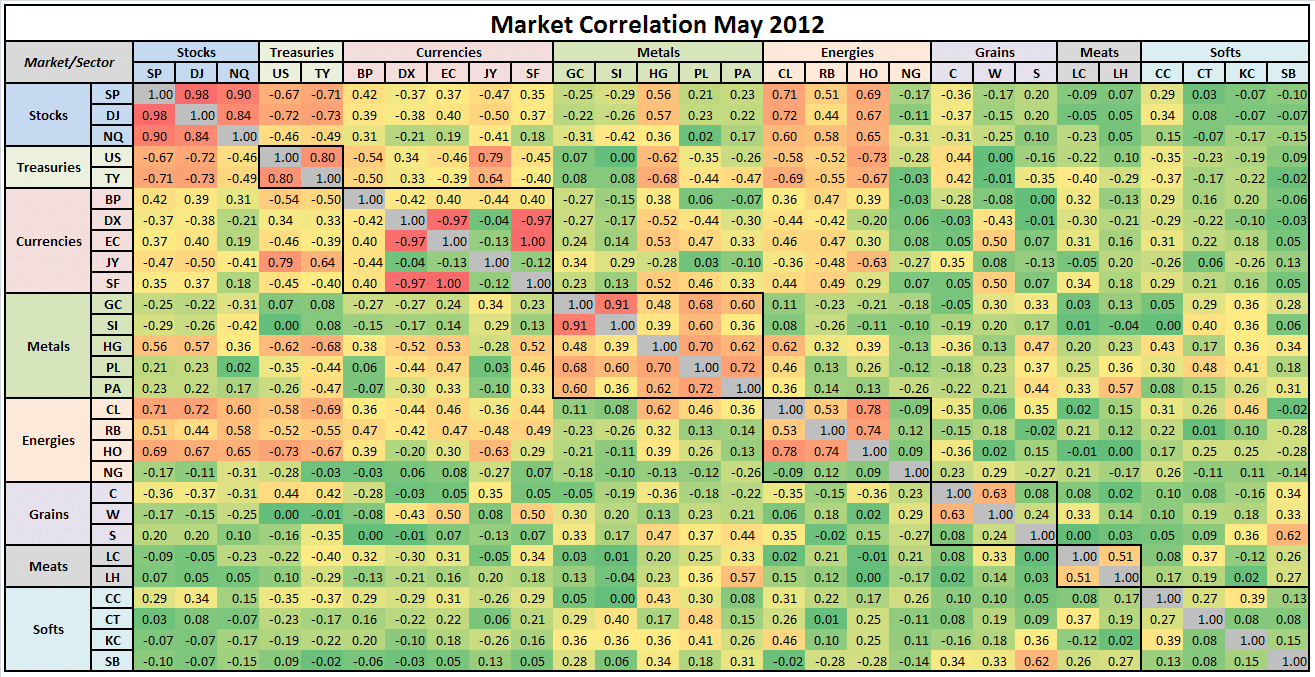
Despite the strong risk off trade this May, the overall market correlation (the average absolute value of all correlations) for the month was 0.28, slightly lower than April and March, which both had market correlations above 0.30. Some of that may be due to large overnight moves in some markets, throwing off the correlation calculations slightly.
With yesterday’s nuclear green continuing into today, these numbers will likely shift pretty dramatically in the month of June, but there’s still a lot of time. That being said, we would not be surprised to see more risk on/risk off trading over the next few weeks as the markets wrap their heads around reality in Europe. For managed futures, this could be bad, particularly if the current move upward persists, but should the past few days revert to the downward trend present since April, it will again be managed futures’ time to shine, in our opinion.