
You know you’re supposed to be diversified in your investments, and that’s just as true for CTAs as it is for any other investor. That’s why CTAs try to trade in futures markets that are non-correlated; it can help reduce risk and volatility. Unfortunately, when the markets move up or down in unison, achieving diversification is much more difficult, and that’s why we’ve started keeping an eye on two statistics that illustrate how easy or difficult it has been to stay diversified in the futures markets: the risk on/risk off trade, and the market correlations.
This risk on/off trade in June was not what we were hoping for, with 6 of the 21 trading days of the month qualifying as one or the other (an average move of +/- 1% in the risk-on markets, for a full explanation of the methodology see our post that broke down the risk on/risk off trade earlier this year.) The percentage of “normal” trading days in all of 2012 fell below 80% this month. Our hope to see an end to the roller-coaster trading environment is not going well so far. The final trading day of June provided striking evidence of this, with the “risk” markets collectively rising a whopping 3.59% (Disclaimer: past performance is not necessarily indicative of future results).
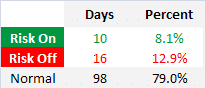
Risk On = average gain of over 1% for “risk” assets; Risk Off = average loss of over -1% for “risk” assets
So how about the overall correlation? As a refresher, correlation is a statistical measure of how interrelated two sets of data are. A correlation of 1.00 would mean that the markets move in lock-step, and a correlation of -1.00 means that they always move in opposite directions. What we’re looking for is non-correlation (a correlation of 0.00), which would mean that the two are behaving as though they are completely unrelated.
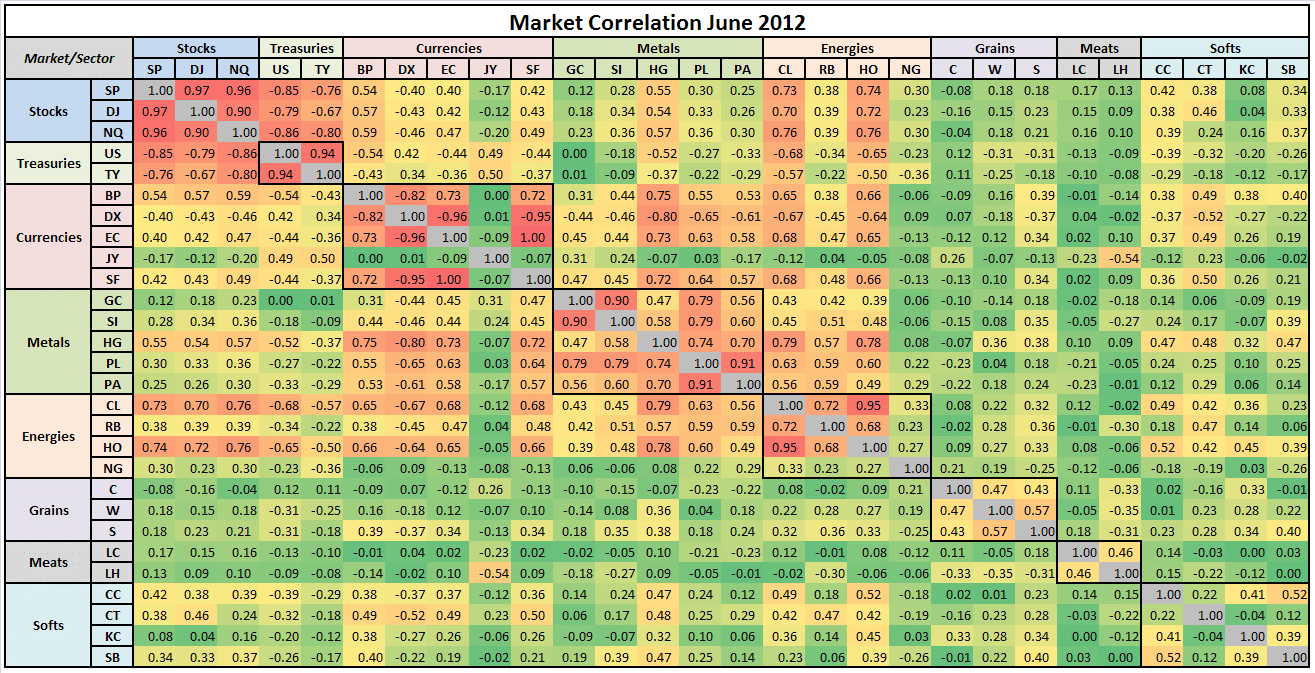
Unsurprisingly, the overall market correlation was higher for June, coming in at .331 (based on the absolute value of correlations). This puts it in line with the high of .334 we experienced in April. Not all was bad news – corn and wheat largely decoupled in June, showing much lower correlations across the board compared to previous months. The weather has played a big role in bolstering the diversification value of these markets. As in previous months, the Japanese Yen has continued to march to its own beat. Natural gas and meats (live cattle and lean hogs) also displayed relatively low correlations across the board.
The first few days of July haven’t provided much guidance in either direction. With Independence Day splitting this week, trading has been a bit quieter. Now that the literal fireworks are over, we’ll be watching closely for signs of more summer fireworks in the markets.