
As election season moves into full swing, there are a lot of angles being pursued on all sides of the political debate. One of those angles has been the dissection of former Governor Romney’s record as CEO of private equity firm Bain Capital. While the initial debate centered on Bain’s outsourcing track record, more recent commentary was far more interesting to us. In taking a look at the performance of Bain rather than the ethics of its methods, Ritholtz makes reference to an eBook from WSJ reporter Brett Arends, which can be found here. One nugget from its pages explains:
From 1984 through the end of 1998, as mentioned above, Bain Capital’s investors put in about $900 million, and the firm’s investments produced gains of about $2.4 billion. This understates the final total a little, as some investments hadn’t fully matured. Nonetheless it’s the best figure we have, and the one most widely relied upon by both sides.
In other words, Bain Capital under Romney made a dollar-over-dollar gain of about 170%. Not annualized: In total.
Ritholtz explained in a recent blog post (emphasis ours):
That sounds like a great deal – but it is a far less attractive when you do the math and compare to other alternatives.
[…] Bain produced all Beta, no Alpha. They used high leverage and took big risk for what was essentially market level rates of return. Any investor who listened to Vanguard’s John Bogle would have done about the same during 1984-1998 – just buy the S&P500 index, and hold it, reinvesting the dividends. The net returns would be ~20% per year — without giant fees or excessive risks necessary.
In my opinion, the whining (from the right!) about Bain’s outsourcing, layoffs, and the fortunes produced for insiders are misguided. That’s not why Bain should be criticized. Their fundamental flaw, at least according to the math, is that they took lots of risk, use immense leverage, and charged enormous fees, for performance that was more or less the same as indexing.
Now don’t get us wrong- we’re always happy when people take sketchy performance numbers to task- but it was the bit about comparing the performance to other alternatives that got us going. You mean… alternatives like managed futures?
Bain Capital touts itself as a bit of a legend in the private equity space, proclaiming on its website, “Bain Capital is one of the world’s leading private investment firms.” So we decided to see how they stood in relation to managed futures programs that also bore that standard in the era – Millburn Ridgefield Corporation Diversified Program, and Campbell & Co. Fin, Metals & Energy. Both of these programs were playing the game at the same time as Bain. Both, like Bain, continue to cater to high net worth investors today in the alternatives space with great respect. So how do they stack up?
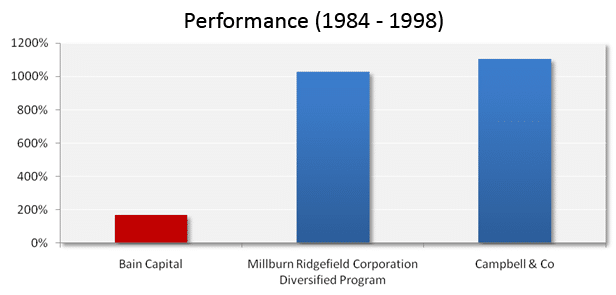
Disclaimer: Past performance is not necessarily indicative of future results.
That’s quite the difference in performance. To be entirely fair, not every managed futures program is going to be a Millburn or a Campbell – and there were programs that crashed and burned over that time period. Even these stalwarts have experienced their drawdowns along the way.
The point is that, during this time period – a time period of robust economic growth in the U.S. and substantial stock market performance – Bain Capital was far from alternative, especially compared to its managed futures peers from the same era. But before you dismiss the titans referenced here as exceptions to the rule, realize that even when looking at diverse indices, like the BarclayHedge CTA Index*, Bain’s performance looks again less than stellar. The index mustered an increase of 474% over 1984-1998 time period, more than doubling Bain’s performance.
In other words, Bain Capital, like many private equity firms, was merely a stock market investment dressed up as an alternative investment. While the world is coming around to the idea that private equity is merely an alternate strategy within the equity asset class, many still trumpet it as an alternative investment which can provide non correlated returns to the stock market.
This is not about linking Romney, Bain and Presidential capabilities. We don’t care who you vote for in November, as long as you put some thought into it. But when you put the thought into alternative investment selection, in our opinion, make sure you know which asset classes (hint: managed futures) give true alternative investment exposure – and which (hint: private equity) are merely sold as alternative investments.