
For all the talk about the ominous economic storm on the horizon, the US has been buffeted more by the actual weather lately – first the drought, and now the storms bearing down on the Gulf. With soon-to-be Hurricane Isaac on a collision course, fears of higher gas prices have been making the rounds in the financial news.
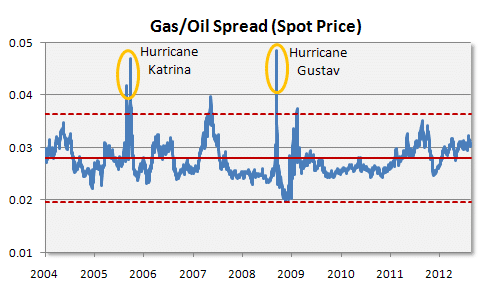
The Gulf is home to a significant chunk of US oil production, and an even bigger slice of the country’s refining capacity (about 23% of oil output and 44% of refining capacity). As a result, a nasty storm, like Hurricane Katrina in 2005 or Hurricane Gustav in 2008, can shut down enough refining capacity to send the spread between oil and gas haywire. We plotted the Gulf Conventional Gas spot price divided by the West Texas Intermediate spot price to show one leg of the so-called “Crack Spread,” the difference in price between unprocessed crude and one of its refined products – gasoline. To give a sense of what’s “normal,” we included the 20-year average, as well as +3 and -3 standard deviations from that average.
Source: US Energy Information Administration. Disclaimer: past performance is not necessarily indicative of future results.
As you can see, we’re nowhere near Katrina or Gustav levels right now, which pushed the spread well above normal levels in 2005 and 2008. In fact, the spread is currently sitting just above the historical average. And Isaac, only forecast to reach Category 1 levels, right now doesn’t appear have the punch of those refinery-disrupting storms of years past. Of course, the only thing more difficult than predicting the financial markets is predicting the weather – and as history has shown, one big storm can certainly roil the gas/oil spread.