
The spike in cotton prices during the beginning of 2011 was one for the record books. Prices hit their highest point since the Civil War (although not if you adjusted for inflation), and worried shoppers the world over wondered if they’d be able to afford their next pair of blue jeans. Well, maybe not, most people outside the commodities world likely didn’t even notice. But it was still an incredible jump in cotton prices. And now, thanks to the CFTC, we’re learning a little more about some of the trading that was going on during that record spike. Via Reuters:
A landmark U.S. fine for excessive speculation in the benchmark cotton futures market has revealed a startling new dimension to last year’s blistering winter price rally: the biggest bull was a Chinese trader with a $510 million punt.
A little-known Shanghai firm called Sheenson Investments Ltd and its founder Weidong Ge, a former trader at China’s vast state-owned agriculture trading company COFCO, have agreed to return $1 million in ill-gotten gains and pay a $500,000 civil penalty for exceeding federal limits on speculative bets in soybean oil and cotton futures, the Commodity Futures Trading Commission said on Tuesday…
With his ownership in Sheenson and a Hong Kong-based fund group called Chaos Investment Ltd, Ge had amassed a position across the market as large as 5,389 lots, about 8 percent larger than the federal limit, the CFTC said. That would have had a notional value of over $510 million as of February 10, 2011, based on the front-month price on that date.
For some perspective… cotton futures contracts trade in intervals of $5 per tic (1/10 of a cent). So with 5,389 lots, and days where the price moved by $0.10 in a day, Sheenson could have been witnessing single-day gains or losses of as much as $26,945,000… in a single day. Not for the faint of heart.
But the story has another wrinkle – the CFTC identified this rule-breaking position and ordered the firm to unwind it – just a few weeks before cotton prices peaked, and then tumbled just as fast as they had gone up. This made for an impressive spike in the Cotton “A” Index (a composite price based on five types of internationally-traded cotton):
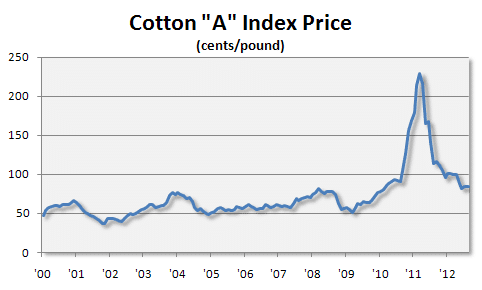
Source: National Cotton Council. Disclaimer: past performance is not necessarily indicative of future results.
Of course, we’re not ones to blame high commodity prices on excess speculation – whether we’re talking about oil, cotton, or just about anything else, it’s the macro factors affecting supply and demand that are the main drivers of commodity prices. As the Reuters article points out,
Although Ge’s position was higher than what is allowed for speculators, it does not necessarily mean it had the biggest trade in the market. Long positions held by hedge funds and big speculators in general accounted for only about a 10th of the total cotton market at the time, CFTC data showed.
Instead, big merchants like Louis Dreyfus’ Allenberg and Glencore are thought of as the biggest players, using the market to hedge their global physical cotton supplies as they buy from Texas farmers and sell to Chinese mills.
The big hedgers still dominate the market, but if this event reveals anything, it’s that the CFTC is getting serious about curbing excessively large positions in commodities futures. Whether that will prevent price spikes in the future – the jury’s still out on that one.