
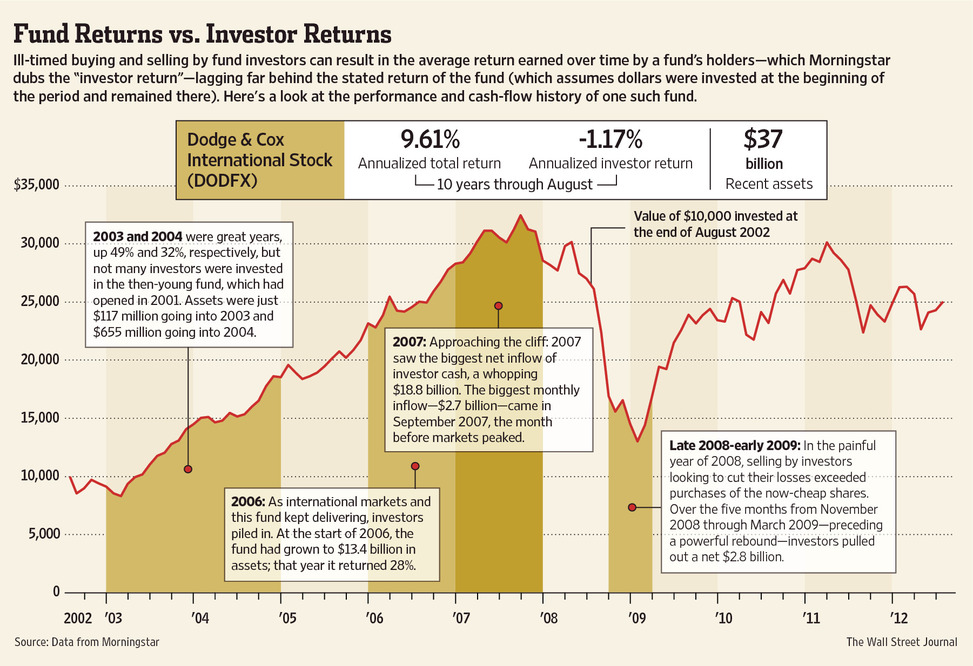
“Buy low and sell high” is about as cliché as investing clichés get, and so is the sobering reality that most investors fail spectacularly at following this axiom. This Wall St. Journal chart (via Ritholtz over at The Big Picture) provides just one more example of how this works:
Unfortunately, it’s not just a stock market phenomenon; we witness it far too often with CTAs, as well. Investors get into a hot program after it’s had a great run, only to experience the disappointing returns that typically follow the good times. After getting frustrated with mounting losses, investors bail out at the bottom, usually just before the program rebounds and enjoys another period of excellent returns. And on and on the cycle goes…
So we had to wonder whether the traditional behavior of “dumb money” was being broken when we saw Josh Brown’s take on the news that investors are flocking to low-cost index funds. Via The Reformed Broker:
What can we learn from this: Investors are being completely rational and logical. When given the choice between higher-cost, actively managed products and effectively zero-cost passive indexes, they are choosing the latter.
Interestingly enough, the research confirms that they are making the correct choice – especially in a low return, low rate environment.
Who you calling the Dumb Money?
So we have investors being completely logical when it comes to cost, but completely illogical when it comes to timing the market (in at the top, out at the bottom). Seems like they may be focusing on the wrong thing. Consider the mutual fund in the WSJ chart above. It has an annual cost of 0.64%, which is many times higher than Schwab’s U.S. Large Cap index fund’s cost of just 0.04%. But while investors could save 60 basis points (0.60% ) going with the low cost index fund, if they are performing the same mistimed entries and exits as those investors in the Dodge & Cox fund example, they are giving away more than 10% in performance by chasing performance and panicking during downturns.
Now, we’re not saying buy and hold is the answer… we’re just saying perhaps it would pay to apply the same logical approach more and more people are using when considering the cost of their investment to the process of considering when to enter and exit that investment.
But, we’re not expecting to see most investors trade in their greed and fear decision-making traits any time soon. After all, we still live in a world where (South Korean) investors load up on the stock of a pop artist’s father’s company when that pop artist has a hit song. Nothing would surprise us at this point.