
2012 is officially in the books, and in terms of asset class performance, the rankings remain similar to what we’ve seen over the past several months. While we will get into the specifics about what generated the managed futures performance numbers in our newsletter this week, and will cover what to expect in 2013 next week (are you signed up to receive our newsletter yet?), here’s how things ended up (Disclaimer: past performance is not necessarily indicative of future results):
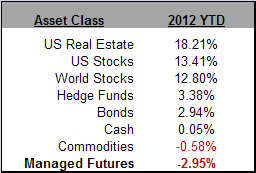
Managed Futures = Newedge CTA Index, Cash = 13 wk T-Bill rate,
Bonds = Vanguard Total Bond Market ETF (BND), Hedge Funds = DJCS Core Hedge Fund Index
Commodities – iShares GSCI ETF (GSG), Real Estate = iShares DJ Real Estate ETF (IYR)
World Stocks = MCSI World Index (ex USA), US Stocks = S&P 500
Here are some of the key takeaways from this final score:
- While the housing bubble’s pain is still fresh in our memories, it looks like we may be well past the time of “hoping” for a recovery. U.S. Real Estate topped the scoreboard this year, and if you ask Bill McBride of Calculated Risk, it’s set up for a stellar 2013.
- Despite what many assumed would be a rocky year, stocks surged ever higher on the backs of low volume and government intervention. How political hijinx play out this year, and how a variety of financial obstacles on the horizon are resolved, will determine their performance next year.
- Hedge funds, in this instance, outperformed managed futures… but still underperformed the stock indices. Managed futures doesn’t promote itself as a perpetual winner when paired against stocks, but for hedge funds, that’s frequently the way they’re sold, and their exposure tends to be skewed towards equities.
- When will the bond bull die? Probably when we stop intervening… or the intervention becomes too over the top to keep confidence afloat. Josh Brown had a good piece about the coming shift in assets away from fixed income and into equities, but the question remains: Will this shift be a gradual reallocation, and part of a longer bull period? Or will the shift be reflective of investors chasing returns to no avail? I guess we’ll have to wait and see.