
January always plays host to a wide variety of ideas about portfolio construction for the coming 12 months. Usually, we brace ourselves for a wide swath of regurgitated nonsense, and try not to let it get under our skin. Except, sometimes, the people talking should know better- a lot better- and we find ourselves in need of rant.
Today is one of those times. Frank Kinnrey, one of Vanguard’s principals, spoke with InvestmentNews, who reported:
Mr. Kinniry said he agrees that the performance of the 60/40 portfolio over the next 10 years isn’t going to come anywhere close to what it’s been historically, mainly thanks to the record valuations and low yields in bonds today. In fact, he warned it could return as much as 50% less than its historical average of around 8% or 9% a year.
But when it comes to managing risk, the 60/40 portfolio is still an adviser’s best bet, Mr. Kinniry said. Chasing after a hot new asset class sets advisers up for failure more often than not, he added.
Hmm, really? Because we’ve run the numbers on this about a million times over… and this is just wrong. In fact, if you go back to 1994, and calculate the efficient return of a portfolio consisting of 40% managed futures, 20% bonds, and 40% stocks, both the Compound ROR AND Volatility are substantially improved over the 60/40 portfolio split. And that includes the past year, where managed futures struggled and stocks rallied.
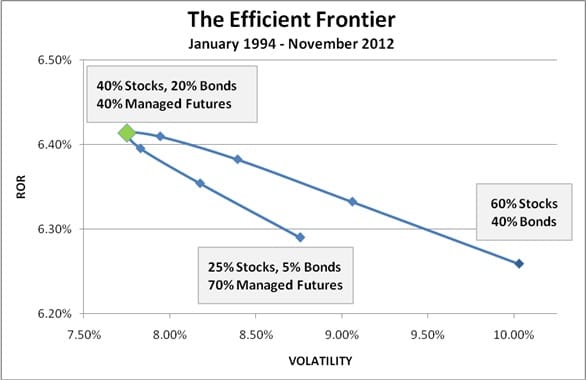
Obviously, past performance isn’t necessarily indicative of future results, and maybe we would have let the whole thing go, but the piece continued:
Managed futures funds, for example, have grown to approximately $9 billion in assets since the financial crisis — thanks primarily to their out performance during that period. Since 2008, however the average managed futures fund has lost money while stocks and bonds have rallied.
Ugh. First off, these folks should know better than to highlight managed futures mutual funds as managed futures proxies. We’ve been over this again and again (and again). Managed futures mutual funds are not the same thing as managed futures. But to add insult to injury, the piece concluded by saying:
Treasurys and investment-grade corporate bonds are the only two asset classes that consistently generated a positive return during the worst stock drawdowns since 1988, according to Vanguard.
Wait, wait, wait… WHAT? You’re saying that these investments are the ONLY assets that have done well in crisis periods?! Not only is that statement incorrect- it’s WILDLY INCORRECT. Crisis periods have not always been kind to those investments, but you know what asset class has done well during crisis periods? Managed futures:

Such is the benefit of allocating to an asset class that can take advantage of up AND down trends across a variety of markets. But let’s talk about consistency, since that seems to be the biggest beef with pursuing alternatives. Unfortunately, even in this realm, the 60/40 blend loses to a blend of 40% stocks, 20% bonds, and 40% managed futures.
To figure this out, we used a test we’d done on asset class performance consistency earlier this year. We compared 12, 24, 36 and 60 month windows of time from January 1994 to November of 2012 for both the 60/40 portfolio, and the 40/20/40 portfolio. We then measured what percentage of time achieved results greater than 0, 5%, 10%, 20% and 30%. For example, if we looked at 100 different 12 month windows (that isn’t 100 years, it is xx years, as each subsequent month creates a new 12 month window), and 50 of those windows were positive, and 50 were negative, we would find the index was positive 50% of the time across 12 month windows. The point of the experiment was to look at what percentage of the time you’d have achieved certain results had you held an investment in each asset class for a given amount of time. Here’s what we found in terms of positive results:

Those numbers are pretty impressive, particularly as the investment timeframe increases. Those figures are uniquely valuable,as they are are most aligned with the average investor’s goals. It’s not often that you hear someone say, “I’m going to prepare for retirement for two years.” When every 5 year window is generating positive returns, and over 72% of those windows generated returns over 20%, that’s not something to stick up your nose at.
To be fair, though, there’s more to investing than positive returns. We’d be remiss to not also consider the downside of things. So we ran the numbers, using the same parameters, for negative results within the same windows of time:

For us, this is where the 60/40 portfolio loses all relevance. The portfolio with alternatives only faced losing periods in a one or two year window, and at a far, far lower rate than seen in the 60/40 blend. The traditional portfolio simply doesn’t come close.
In other words, the 60/40 portfolio is STILL a bad idea. It’s better than the 100/0 portfolio to be sure, but simply look at the numbers (all of them, not just the past few years) to see that it is less consistent and more risky than a portfolio containing managed futures.