
We don’t deal in the world of AAA ratings in the managed futures world, where programs are reviewed by investors on their own merits and decisions are made by investors without the aid of a ratings crutch. But the bond world (and in turn the mortgage-backed security world) lives and dies by these credit ratings.
With that world mostly dying during 2008, the ratings agencies have come under some pressure of late. That the big 3 ratings agencies failed to accurately judge the risk of mortgage-backed securities is clear in hindsight, but should they have known beforehand? The Department of Justice’s case against S&P, announced earlier this week, alleges that not only should they have known, but that their failure amounted to more than just incompetence – it was downright criminal. McGraw-Hill, S&P’s parent company, has been on a nosedive since news of the case broke:
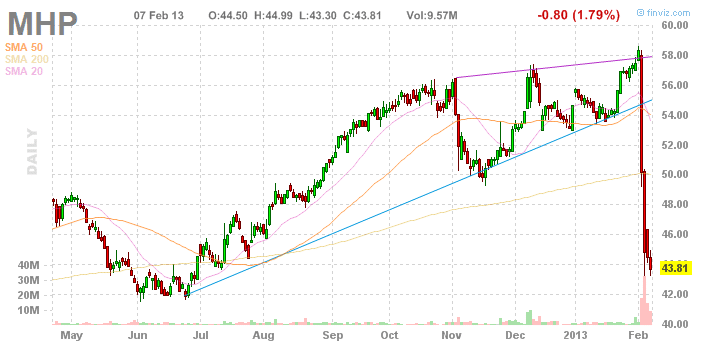
Chart courtesy Finviz.com. Disclaimer: past performance is not necessarily indicative of future results.
But it’s not immediately apparent that the Justice Dept. has an airtight case here. It won’t be enough to prove that S&P failed – after all, there’s no law against incompetence. They must prove that S&P knowingly ignored warning signs… and that could be much more difficult.
But there are some interesting wrinkles to this case that suggest the DOJ may be attempting to stack the deck in its favor. To wit: the choice to file the case in California rather than New York. It could be a coincidence… or it could be a strategic choice, as the Economist speculates:
It is unusual for such an important financial case to be filed in Los Angeles. The suit cites the Western Federal Corporate Credit Union (WesCorp), a financial firm based in Los Angeles county that collapsed under the weight of losses from mortgage-backed securities. But the DoJ may have also been hunting for a favourable jurisdiction. Losses from these sorts of bonds were spread across America. The issuing banks, ratings agencies and various witnesses are all based in New York, where such litigation is usually filed.
File it in California, where Wall Street’s influence is less likely to work in S&P’s favor. Will it work in the DOJ’s favor? Well, it surely couldn’t hurt.
For S&P, the stakes are high. One would think that their spectacular failure to adequately judge risk in the past would be enough to cause markets to disregard their ratings, but it’s not that simple. Many institutional investors are bound to the ratings from the big three (S&P, Moody’s, and Fitch) in some way. However, it’s not hard to imagine that a successful criminal prosecution could be enough to prompt a rewrite of some of these rules, further marginalizing S&P.
So what is S&P’s response strategy? Based on their initial public statements, one of their defense strategies looks pretty clear. Businessweek explains:
A central element of S&P’s defense is expected to be that its overly generous evaluations of complicated mortgage-backed securities were no different from those of Moody’s or the No. 3 service, Fitch Ratings. In other words, S&P would insist it was no dumber than its rivals—and certainly not a fraudster. “Claims that we deliberately kept ratings high when we knew they should be lower are simply not true,” Catherine Mathis, a McGraw-Hill spokeswoman, said in a statement.
“We’re not criminals because everyone else was doing it, too!” Of course, if Holder has plans to prosecute Moody’s and Fitch later, this might not prove to be the best defense. The conspiracy theory angle suggests that the US has singled S&P out for their decision to downgrade the US in 2011. Holder vehemently denies this, and it’s worth noting that Moody’s shares have been falling at the same time as McGraw-Hill’s. If this suit is successful, it’s not too difficult to imagine that they might be next.
But regardless of the DOJ’s longer-term plans, this could set a huge precedent for credit ratings agencies. Issuing bad ratings won’t be a matter of “buyer beware,” but a crime subject to harsh punishment. In the short run, it means someone being held accountable for the financial crisis. And maybe, just maybe, it will solidify the notion that credit ratings are just the opinion of one group of analysts – which aren’t likely to do any better than other market prognosticator’s picks and pans.