
There’s a reason why we prefer managed futures – which can go long or short various commodity markets – to long-only commodity positions. In addition to our misgivings about the vehicles many investors use to gain commodity exposure, there’s another big problem: there’s no guarantee that commodity prices are going to rise. And investors who added long-only commodity exposure to their portfolios in the last few years expecting to ride the wave of a “commodity supercycle” are now reconsidering the wisdom of those bets. Via the Wall St. Journal:
The Dow Jones-UBS Commodity Index fell 1.1% in the first quarter, and the lackluster performance could add further fuel to detractors’ argument that the commodity supercycle is over for now. The index fell 1.1% in 2012 after declining 13% in 2011…
Some investors may view the markets’ relative stasis as a bottom and the opportunity for a rebound. But the days of ever-rising commodity prices are gone for the moment, leaving markets that are no longer friendly to a buy-and-hold investor. The moneymaking opportunities now are in complex, volatile trades, like spreads between contracts of varying months, strategies used by professional investors, or approaches like buying stock in natural-resource companies.
Long only-commodity positions did look great heading into the 2008 crash, but prices have generally stalled over the last few years. So much for QE ushering in rampant inflation and soaring commodity prices. Anyone who has jumped aboard the Jim Rogers bandwagon, expecting their long-only commodity bets to pay off has been sorely disappointed over the last couple of years:
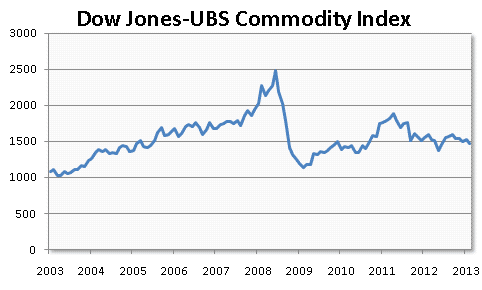
Disclaimer: past performance is not necessarily indicative of future results.
The Rogers camp would have you believe that the nice, upward sloping trend that held from 2003-2008 will resume any day now. And granted, it’s entirely possible that commodities will resume the upward trajectory of the early aughts. But this is a very good illustration of why dabbling in commodities is not for the faint of heart. And a good reminder of why we prefer the managed futures approach to commodity investing – where falling prices can be just as welcome as rising prices.