
When a friend of ours headed to the World Series of Poker last summer mentioned basing his bet size on Fortune’s Formula, and we gave him a semi-blank stare – he told us to go pick up the book Fortune’s Formula: The Untold Story of the Scientific Betting System That Beat the Casinos and Wall Street
William Poundstone’s book is ostensibly about the Kelly Criterion, a formula used to calculate the optimal bet size given one knows their probability of winning and the payout odds for a winning bet. An example from Wikipedia: if a gamble has a 60% chance of winning (p = 0.60, q = 0.40), but the gambler receives 1-to-1 odds on a winning bet (b = 1), then the gambler should bet 20% of the bankroll at each opportunity (f* = 0.20), in order to maximize the long-run growth rate of the bankroll.
But the real story is the historical characters laid out therein.
There is Claude Shannon – the father of information theory whom Poundstone argues was on Einstein’s level. Ed Thorp, who adapted the Kelly Criterion to card counting and playing blackjack to several successful hedge funds. There is mobster Manny Kimmel, who turned a parking lot won in a craps game into a parking lot company which eventually bought film studio Warner Brothers, which eventually became Warner Communications, and eventually merged with Time Inc. to create the Time Warner whose internet connection you might be using right now. There is the story of a young Rudy Giuliani fighting crime in New York. There is Boesky and Milken and Merton Shcoles and Fisher and Black and Merriwhether. And a great Warren Buffet fable about every person in the US flipping coins we hadn’t seen before.
Then there are the lessons gleaned. Such as why insider trading is so appealing to those utilizing the Kelly criterion (because the odds of success go way up), and how overbetting even on a positive expectancy outcome can result in ruin. There is talk about the failings of VaR and Black Scholes and Long Term Capital Management. And there is the overarching lesson of the Kelly Criterion that risking a fraction of your bankroll (investment amount) on each successive “bet” removes the risk of ruin (ignoring minimum investments or table minimums, and the like) while providing the largest possible long term growth.
Below is the graph from the book comparing four money management systems using a simple example of even money bets with a 55% chance of winning. You can see the brief flame out of the bet it all bettor. The deceivingly smooth line of the Martingale bettor (if you lose, bet double the next time) except for the large drawdown during a losing streak, the slow and steady gains of the fixed wager – and finally the volatile but largest gainer in the Kelly method. (Excuse the quality of the image – it was pulled from somewhere on Google and likely a scan from the book, not created digitally by us.)
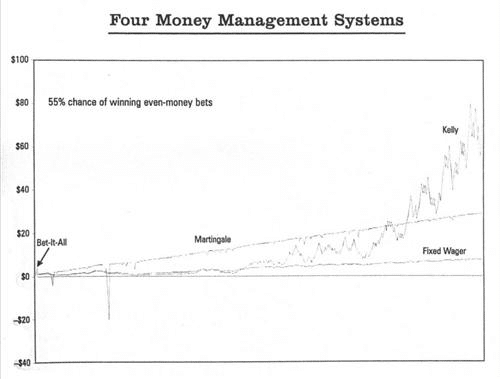
We couldn’t help but keep thinking back to systematic trading models in the managed futures space in reading the book, because fractional betting on the ongoing bankroll is how managed futures operate for the most part: risking a fraction of the investor’s ongoing account on each trade so as to reduce trading during a losing streak and compound winning by larger bet sizes during winning streaks. We know two things for sure. One, we’ll be adding this book to our list of market favorites, and two, we’ll be asking managers we talk to from here on out their views on the Kelly Criterion are… and docking them a few points if we get that blank stare back.