
When AQR’s “100 Years of Trend Following” study came out, one of our favorite parts of the piece was the great use of data visualizations, including their look at the “smile curve” that takes shape when plotting managed futures returns vs stock returns. The idea is pretty simple – managed futures returns are higher when stocks are either doing very poorly, or very well. Charting that relationship creates a smile shape, with managed futures returns at their lowest when stock market returns are around zero – in other words, during choppy, sideways markets.
Now, a new paper from 1741 Asset Management has created a similar set of charts using monthly data, and they’ve added in bonds and commodities for good measure. Using the shorter time frame flattens the curves somewhat, leading to more of a “smirk” curve, but it also helps show more nuance to the data than AQR’s charts could display:
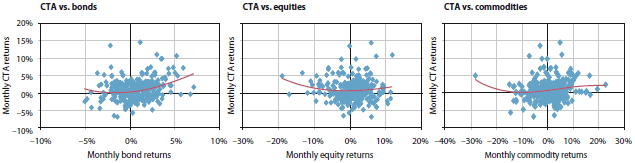
Managed Futures = Barclay BTop50, Bonds = Citigroup WGBI All Maturities USD,
Commodities = MSCI TR Gross World, Stocks = S&P GSCI Official Close Index TR.
Disclaimer: past performance is not necessarily indicative of future results.
There are a few things that jump out at us looking at this. First of all, the tilt of the curve between bonds and equities is nearly a mirror image. Managed futures has historically prospered far more during boom months for bonds, while sporting relatively lower average returns when bonds are falling. For equities, the relationship is reversed, with managed futures loving down months in stocks significantly more than positive months.
This effect is explained by the skew in the magnitude of returns for bonds vs equities. The equity returns on the upside are far more clustered between 0% and 10% than on the downside, which has months well past the -15% mark. The reverse holds true for bonds, where the scattering of outlier moves is on the upside.
The commodity chart is the most intriguing. There is the huge outlier move of -30% returns in commodities (when managed futures stepped up), but there is a flattening of the curve on the far right of the chart for the outlier up moves. And indeed the whole CTA vs commodities curve is rather flat when compared to the other two. Are we perhaps seeing the effect of their use of the BTOP50 index, which tracks the largest CTAs in the industry (currently the 20 largest)? As we’ve seen in the past, those big CTAs have tended to move away from commodity markets – perhaps explaining why big commodity moves to the upside really don’t move the needle that much. We wouldn’t be surprised to find that smaller CTAs would participate in a large commodity market down move in the other asset classes as there would be flight to safety, and it is less likely that a commodity outlier is caused by global economic factors (and more likely caused by drought, oil embargo, etc.).
At the end of the day – the biggest takeaway is the placement of these curves above their 0% line (on average they are positive no matter the environments), and their ability to point up at the corners (so called fat tail performance).