
It seems like just yesterday, the infamous drought of 2012 was upon us. It was a perfect storm (or lack thereof) of dry conditions causing the worst drought since the 1930’s. You couldn’t walk two blocks without sweating, most of the Midwest forgot what rain felt like, and farms survived a horrid planting season. Because of that, grain prices skyrocketed. Needless to say, 2013 has been the polar opposite (mid temps, more rain than you could ever want.) Check out the drastic differences in Wisconsin, Illinois, Indiana, Iowa, Missouri, and Arkansas courtesy the U.S. Drought Monitor.
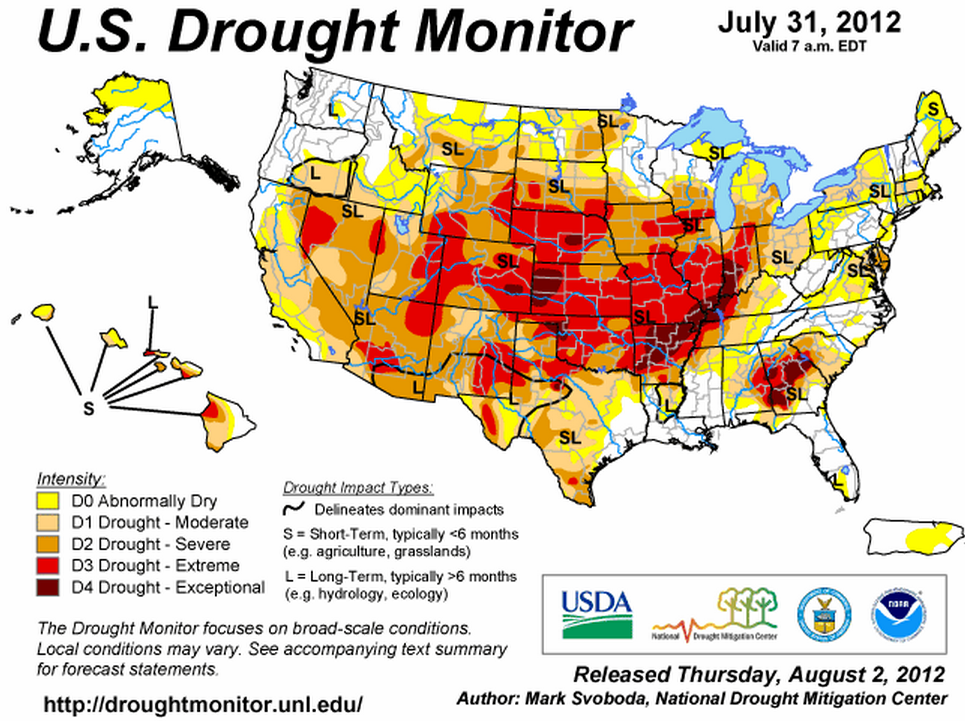

Courtesy: U.S. Drought Monitor
As you can see, parts of the U.S. is still dealing with the aftermath, but the show must go on. Once again all attention is on weather this time round, as agriculture trading is front and center and planting season wraps up and analysts begin prognosticating on the potential output for new crop beans, corn, and wheat. It probably won’t be surprisingly to check out the 2013 record breaking numbers for rainfall.
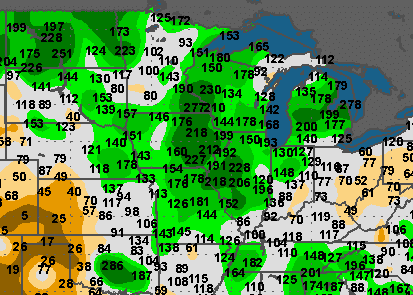
Courtesy: M6 Capital Management
What’s it all mean for the coming harvest time?
We were lucky enough to sit down with M6 Capital Management before the MFA Forum 2013 in Chicago, welcoming Chris Meyers and Craig Holliday of to our office for a roundtable discussion (actually – we have a square table) on the grain markets and their trading strategy. Imagine a good Mississippi accent talking rainfall amounts and crop yields, and you can picture the discussion. But they also shared their recent ‘outlook’ paper with us, and while the commentary is certainly interesting (especially if you’re market addicts like us), the bigger picture is that investors can see the “behind the scenes” type thinking and strategizing that makes a fundamental ag trader tick. Send us an email if you want a copy of the whole report.
M6 points out that the markets have adjusted to these planting delays, as prices for new crop contacts have rallied (although they were down today.) M6 says even if farmers lose a few acres of planting, soybeans should be ok.
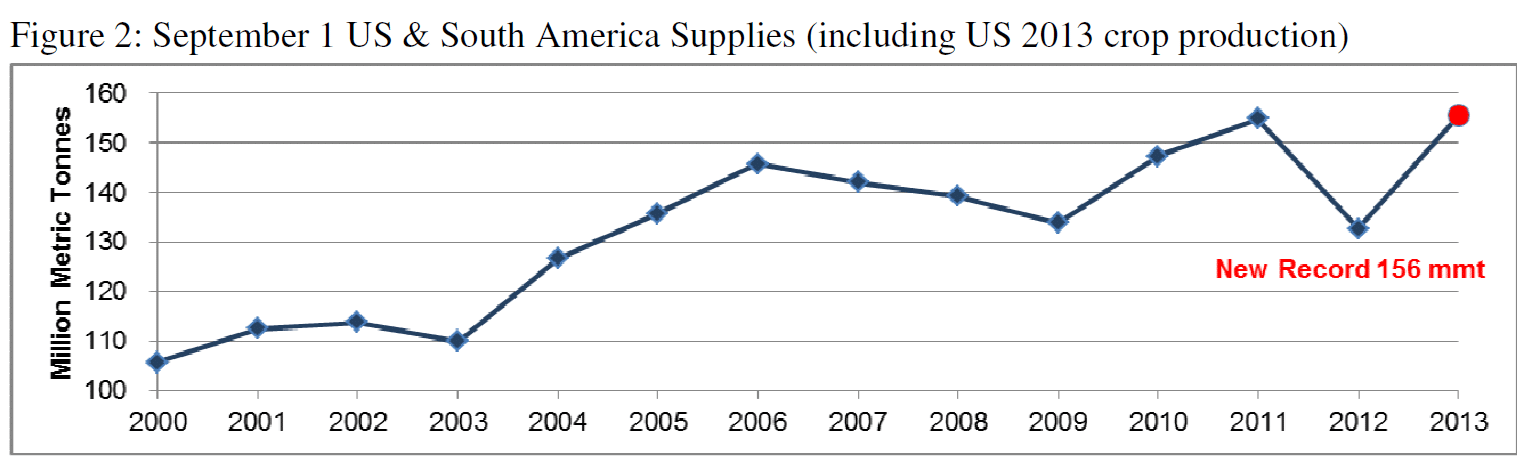
“Figure 2 is a chart of September 1 soybean supplies in the largest world producers (US and South America). This chart assumes that we get the US soybean crop planted and we have trend yields. Note that if this occurs, then we could have supplies 23 million metric tons (17%) larger than last year. Therefore, if weather allows the completion of US soybean planting, supplies will be plentiful, and we would expect the price of November soybeans to be significantly lower by harvest time.”
Courtesy: M6 Capital
17% higher supply than last year and a prediction of Nov. beans significantly lower by harvest time. What a difference a year makes.
So what’s the hub-bub about corn? M6 says that’s a different story.
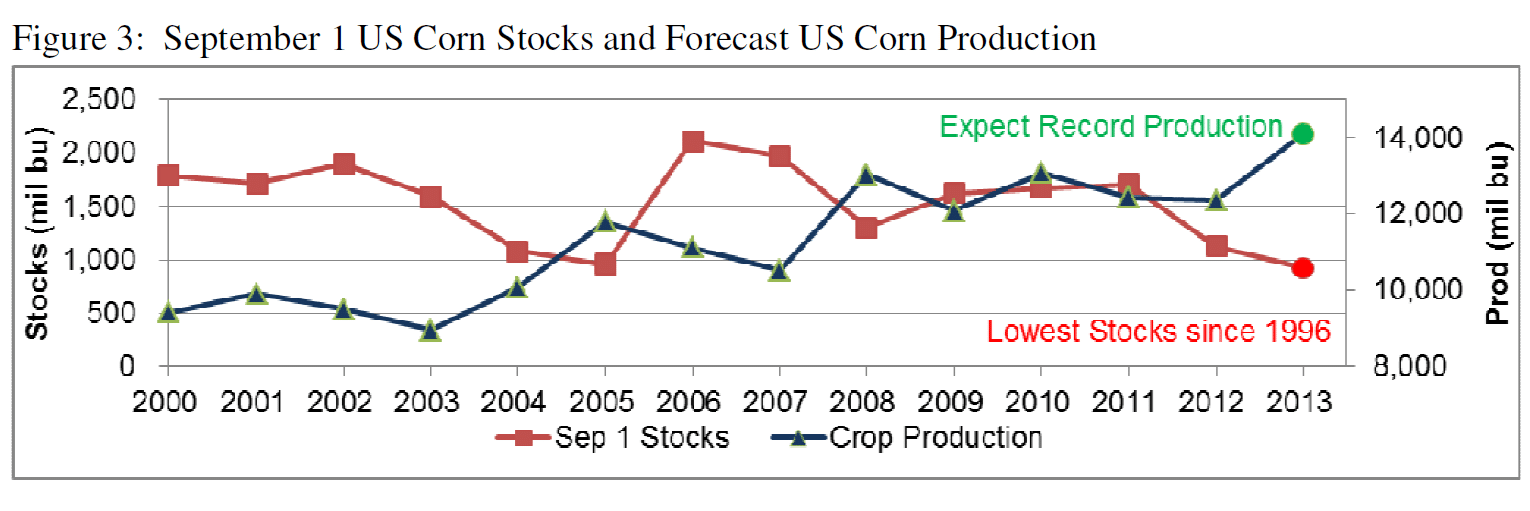
“Supplies of US corn are very tight right now and are likely to stay tight well into early parts of harvest. We will likely have decent supplies of corn once harvest occurs, but getting from tight supplies in June to decent supplies at harvest (October) will likely be very tricky. Under this scenario, the nearby contracts stay firm, and the December corn contract trades lower as the crop develops. Figure 3 below shows the contrast from small stocks to large production.”
Courtesy: M6 Capital
Mr. Meyers certainly knows his way around a crop report – and with eight years of trading as a CTA under his belt and $48 million in AUM, we believe he is poised to make the next jump in his trading career. We have been following the trading at M6 for the past twelve months and recently added the program to our recommended list earlier this month. For a more in depth look at the program read our Managed Futures Spotlight on M6 we published in February.
(If you would like a copy of the entire M6 newsletter, please email us and we would be happy it forward it to you. Otherwise, check out our free newsletters here.)