
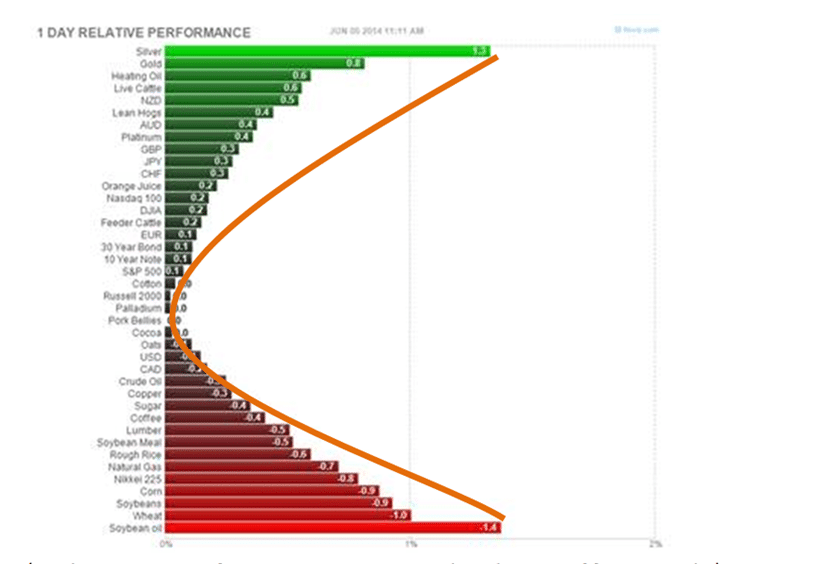
Drilling down to the day-to-day gains & losses can be dangerous for your wallet and psyche when analyzing trend followers, but when we checked out today’s futures market performance on Finviz we noticed something unique… a sideways bell curve.
 (Disclaimer: Past performance is not necessarily indicative of future results)
Chart Courtesy: Finviz
While most people grew up excited to hear that their teacher/professor was going to grade the test (you didn’t study for) on a bell curve (the highest grade in the class becomes the 100%, and each grade is adjusted from there), this sideways bell curve means something a little different.
You see, when the futures markets work in tandem to average a gain of over 1% or average losses over -1%, it’s referred to as a Risk On/Risk Off day. (See our most recent 2014 Scoreboard here). But this might be a perfect example of a day showing an average return of 0%, meaning, each market is zigging, while the others are zagging.
What does this mean for trend followers as well as other managed futures strategies? Well, nothing really. Trend followers love to see charts like this, but one day isn’t enough for managers to capitalize off of their trends. They want to see days like this repeat themselves for months, and hopefully even years. The wheat market is continuing its down trend over from May into June, now down 16 of the last 19 days, but managers want to see a trend like that continue for months to come, with no reversion.
Managed futures don’t just need markets moving on their own – they need them moving on their own in a consistent direction.
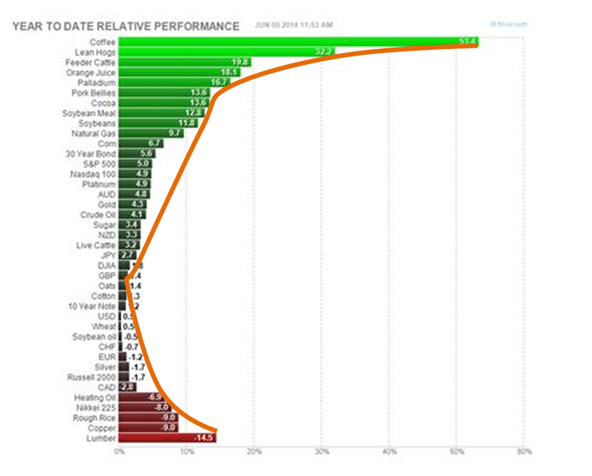
For example, the curve isn’t so even if you look at the YTD performance, with 22 of the 40 markets only showing a positive or negative 5% performance YTD {Disclaimer: Past performance is not necessarily indicative of future results}.
 (Disclaimer: Past performance is not necessarily indicative of future results)
Chart Courtesy: Finviz