
One common criticism of managed futures seems to pop up over and over again – the idea that CTAs returns are nothing more than a tailwind from investing idle capital in T-bonds. We’ve addressed this particular argument before, but it’s a belief that just won’t go away. In reality, there are a number of reasons why managed futures love bonds that have nothing to do with that interest rate tailwind.
But recently we came across this great piece from Campbell & Company looking at the effect of rising/falling interest rate environments on managed futures, stocks, and bonds. And what did they find?
Specifically, we found no apparent relationship between the direction of treasury yields and the historical performance of the Barclay CTA Index. This may surprise those readers that attribute CTA profits mostly to holding static long positions in fixed income during the 30-year rally in Treasuries.
While this reinforces our argument that CTA returns are based on much more than just the going 10-year T-bond rate, it also seems to be at odds with what we’ve written in the past about the tantalizing possibility of a bond bear (rates higher, bond prices lower). We’ve always argued that a sustained increase in interest rates – or even a bond “crisis” of sufficient length – could provide an excellent opportunity for managers to profit from the trend. Do these results suggest that we’ve been wrong?
Not exactly – their results showed no linear relationship, but it did display a second order regression, what they term the “smile” line:
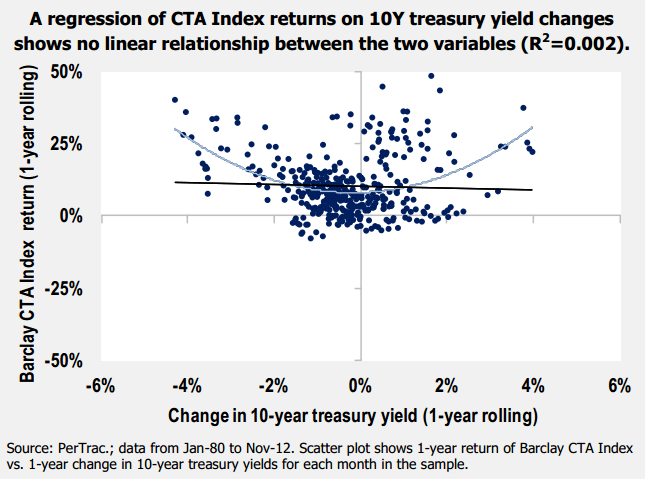
Although it’s admittedly based on a small sample and must be taken with a grain of salt, that “smile” indicates exactly what we’ve always argued – that when rates change rapidly (in this case, a move greater than +/- 2% within a year) managed futures will tend to prosper. (Disclaimer: past performance is not necessarily indicative of future results.)
We’d love to see what that curve looks like on different time scales, but as is, it’s yet another bit of data that leaves us eager for the eventual arrival of a bond bear.
See Also: