
The CME’s mergers/purchases of the CBOT and NYMEX went a long way toward cementing their role as the world’s primary exchange for a variety of futures contracts – especially grains, livestock, and energies. Their importance in the global oil industry was bolstered by the fact that WTI crude, which is primarily traded on the CME’s exchanges, was the preferred global standard for oil futures trading. But nothing’s static in the futures world, and the CME’s grasp isn’t looking quite so cemented these days. A Dow Jones Business News article reports:
In April, monthly trading volume in West Texas Intermediate crude-oil futures traded on CME’s New York Mercantile Exchange was overtaken by the Brent oil futures offered by ICE. Now, analysts believe, open interest on the Brent contract–a closely-watched measure of trading activity and market liquidity–is set to overtake WTI, based on the recent trajectory of market activity.
Being home to the most-traded oil contract is important to exchanges like CME and ICE because traders gravitate to the most-liquid markets. Capturing the crude crown would be a boost for London, whose commodity-trading profile has increasingly come under threat from traders shifting to Geneva, partly for tax reasons.
The success of ICE in the oil-futures market is viewed as a sign of the threat it poses to CME overseas. ICE has been buoyed by the prospect of buying NYSE and its prized London-based Liffe derivatives unit, just as CME prepares its own long-awaited push into Europe.
Part of this is driven by the market itself – WTI hasn’t been quite as useful an indicator of global oil prices due to a prolonged supply glut in Cushing, OK. The two tracked each other very closely up until late 2010, at which point the consistently lower price of WTI took hold:
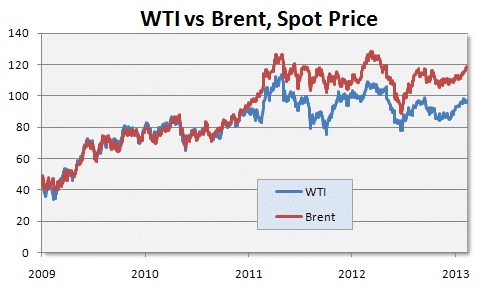
Disclaimer: past performance is not necessarily indicative of future results.
And as more traders begin to view Brent as a better reflection of the global oil market, ICE benefits due to their larger share of the Brent trade.
This is just another volley in the growing global competition for futures volume, and ICE’s intention to purchase of NYSE Euronext (announced in December) may soon become a reality, as well. That move is awaiting only regulatory approval, and would be a huge boost to ICE’s ability to compete with the CME.
This is an industry where scale is incredibly self-reinforcing; the biggest investors in the field seek the most liquid exchanges, which in turn makes those markets even larger (and more liquid). It’s a positive feedback loop that could spell trouble for the CME if they begin to fall behind.
Of course, the CME isn’t just sitting back and watching – they’re pursuing their own effort to expand into Europe, in the hopes of claiming a larger share of the currency futures market from ICE. And they remain unrivaled in the US… but that may not count as much as it once did. The flurry of mergers and purchases over the last decade has narrowed the field, raising the stakes for this battle for a bigger share of the world’s futures markets.