
Keeping tabs on market correlation is a fundamental part of risk management because understanding correlation is key to diversification. If various markets are moving up or down in unison, risk and volatility can quickly grow beyond your expectations. That’s why we’ve started keeping an eye on two statistics that help illustrate how easy or difficult it has been to stay diversified in the futures markets: the risk on/risk off trade, and market correlations.
Risk On, Risk Off
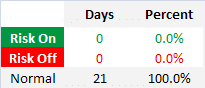
One of the proxies we use to keep track of market dynamics is the number of risk on/risk off days in the year. We define risk on as an average gain of over 1% for “risk” assets; risk off is an average loss of over -1% for “risk” assets. (Click here for a more detailed breakdown.) So, how did January’s tally wind up?
(Disclaimer: past performance is not necessarily indicative of future results.)
That’s right, not a single one of the first 21 trading days of 2013 counted as either risk on or risk off according to our definition. In our 2013 outlook we posited that we might see more of a return to “normal” this year, but we certainly didn’t think we’d see a shift to 0% risk on/risk off days. As we pointed out in that newsletter, the percentage of days that are risk on or risk off has been declining since 2008, and on a smaller time frame the downward trend is apparent since the spike we saw last May:
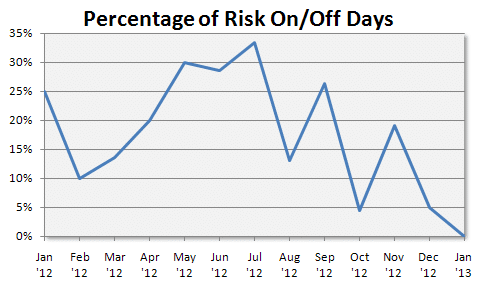
Prior to 2008, the yearly average of risk on/risk off days was between 10%-20%. It will be a while before we can say that 2013 has bucked the trend of roller-coaster years, but starting off the year at 0% is certainly a step in that direction.
Market Correlations
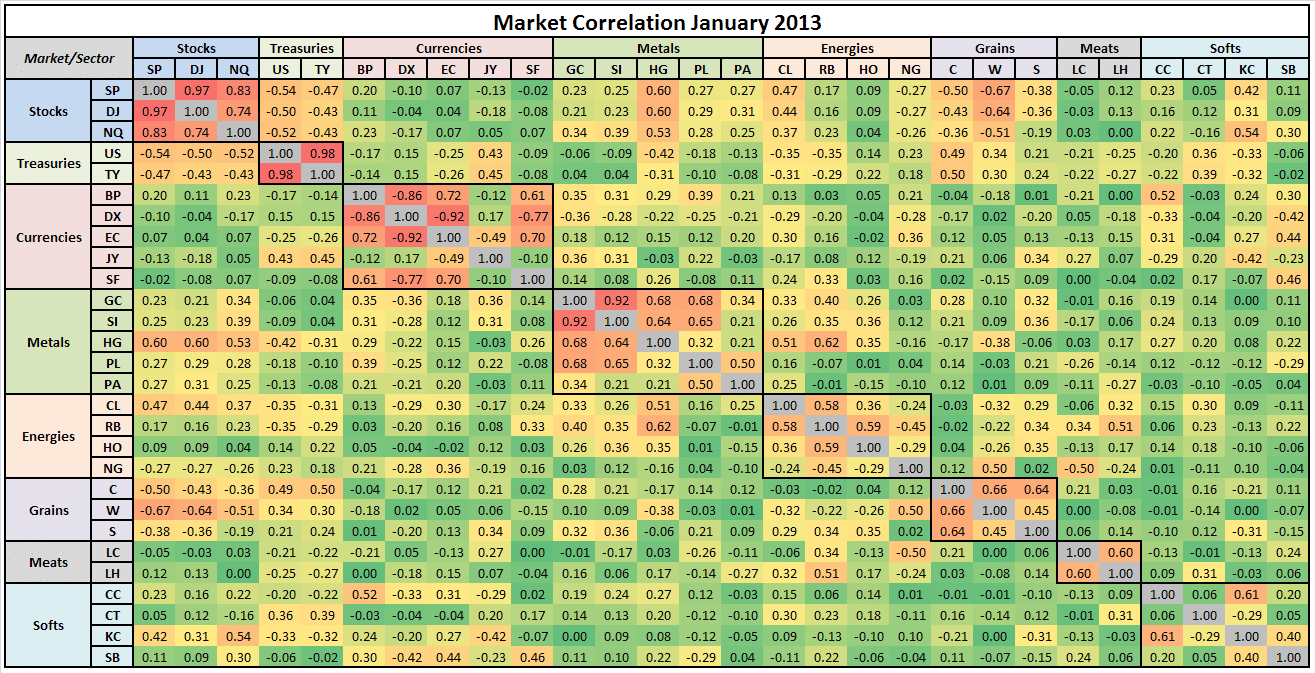
How about correlations? As a refresher, correlation is a statistical measure of how interrelated two sets of data are. A correlation of 1.00 would mean that the markets move in lock-step, and a correlation of -1.00 means that they always move in opposite directions. For diversification value, what we’re looking for is non-correlation (a correlation of 0.00), which would mean that the two markets are behaving as though they are completely unrelated.
The overall market correlation in January was .23 (based on the absolute value of all market correlations).That figure is much lower than the monthly averages we saw throughout 2012, which tended to lie in the .27 to .33 range. These statistics are not perfect measures of the diversity of market activity, but they do indicate that 2013 is off to a more “normal” start. Much can change before the year ends (and it almost certainly will), but for now, we’re not complaining.
Disclaimer: past performance is not necessarily indicative of future results.