
When we categorize CTAs, we tend to group all the traders who focus on agricultural markets together. Whether their trading methodology is that of a trend follower, discretionary trader, or even options; it is the focus on Ag markets that we find to be the most meaningful. We’re not alone in this: the BarclayHedge CTA Index breaks out the performance of Agriculture Traders, or Ag CTAs, too.
Now, the BarclayHedge categorizations are self-reported, so take it with a grain of salt (pun intended); and we’ve talked a lot about the good performance of Ag traders last year, but with the 2012 numbers nearly all in, we couldn’t help but share the BarclayHedge subindex performance of 2012:

Disclaimer: past performance is not necessarily indicative of future results.
As we pointed out in our 2012 strategy breakdown, while most of the managed futures world saw losses or only modest gains, Ag CTAs put up a respectable 5.4%. The key here is that grain markets tend to be very closely aligned with factors that are unique to those markets: USDA reports, choices that farmers make about planting/selling their harvest, and as we saw this summer, the weather. And that can often translate into big moves independent of the rest of the market, like corn’s 7.5% rally over the last week or so:
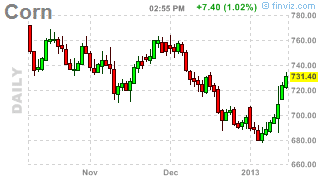
Chart courtesy Finviz.com.
Against this backdrop, some Ag managers are off to a great start, with M6 Capital up an estimated 1%, and Rosetta Capital up an estimated 1.3% so far in 2013. (the maximum drawdowns for those programs are -15.4% and -39.7%, respectively). (Disclaimer: past performance is not necessarily indicative of future results)
However, this should definitely not be read as an argument that Ag CTAs are “better.” The fickle grain markets can be a double-edged sword, just as easily dragging Ag traders down if the conditions are wrong. Case in point: last year Global Ag gained 14.5% in April, only to give it nearly all back with a -12.1% loss the next month. In the end, though, an outstanding 2nd half of the year left Global Ag up an estimated 35.2% for 2012 (its maximum drawdown is -17.6%). (Disclaimer: past performance is not necessarily indicative of future results) And as always, we don’t recommend performance-chasing, or getting into one of these programs while it’s still “hot.” The best approach, in our opinion, is to invest when a solid program enters a drawdown period, to hopefully capitalize on the climb back to new equity highs.
In the end, like always, it comes down to diversification. You wouldn’t put your entire equities allocation into a single stock, and you shouldn’t count on one CTA (or one type of CTA) to provide managed futures exposure. Grain exposure is part of a balanced portfolio that, in 2012 at least, proved quite valuable.