
Last year we wondered if natural gas was becoming a “flight to quality” play; rising on days when traditional “risk” assets were decidedly down, in a sort of Japanese Yen sort of market setup where investors thought something along the lines of “well, it can’t go any lower!”
And with natural gas ahead by 2% to 3% today while stocks and other “risk on” assets are down (Disclaimer: past performance is not necessarily indicative of future results), natural gas’s curious price action on down days continues:
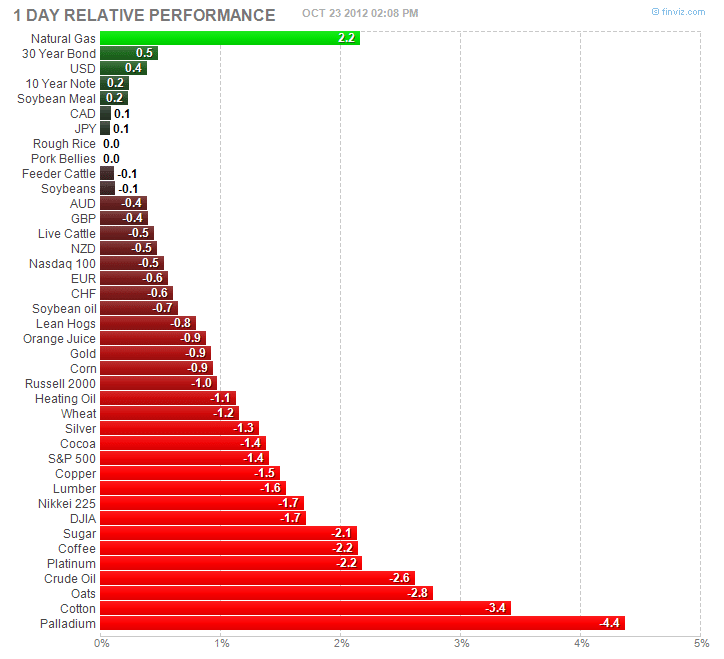
Chart courtesy Finviz.com.
Of course, natural gas has acted like anything but a “flight to safety” play since its lows in April, gaining about 70% since that time and rising right alongside the stock market. That is – until today. Are there algos out there programmed to start buying Natural Gas when S&P futures drop by more than a certain amount, or are we just seeing patterns where none exist? Who knows, but our guess is that you’ll be hearing a lot more about natural gas moving forward. The US is awash in it – and as Daniel Yergin opined the other day in the WSJ, it will be an economic, environmental, and political issue for years to come:
…The energy revolution will add an estimated $62 billion to federal and state revenues this year.
But the energy revolution is having other effects that get less attention… The growth of shale gas will save the U.S. from spending $100 billion a year on imported LNG, which was the likely prospect five years ago.
There is also a geopolitical dimension. The increase in U.S. oil production since 2008 is equivalent to almost 80% of what was Iran’s export level before the imposition of sanctions on the Tehran regime. Without the additional oil coming from the surge in U.S. oil output, the Iranian oil sanctions could not have worked as well as they have.
Domestically, growing natural gas supplies provide a foundation for a manufacturing renaissance, at least for industries for which energy is an important feedstock or where energy costs are significant. Chemical companies have been leaving the U.S. for years in the search for lower-cost countries in which to operate. Now they are planning to invest billions of dollars in new factories in this country because of inexpensive and relatively stable natural gas prices. The price of natural gas, which averaged $2.66 per thousand cubic feet in the first nine months of this year, is less than half of what it was five years ago.
This holds out a tantalizing prospect that the U.S. could regain market share among the world’s manufacturing exporters…”
Related: