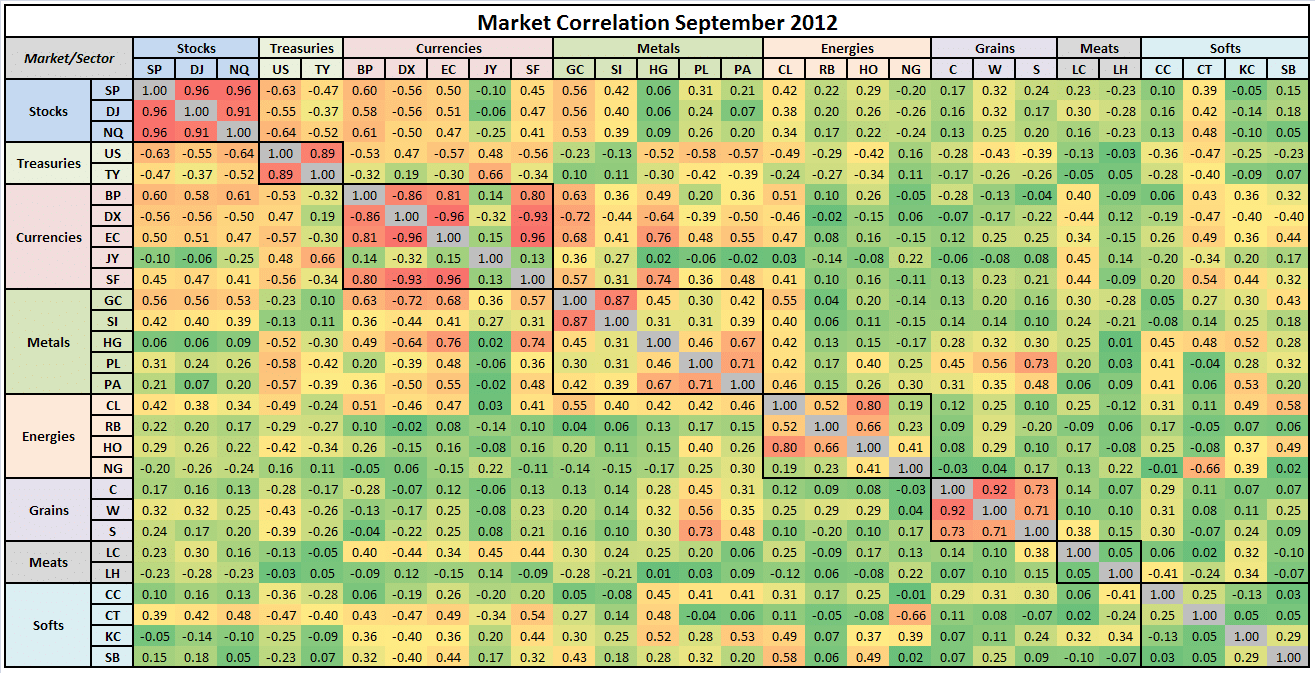
When markets are highly correlated, it can be tough to stay diversified. If various markets are moving up or down in unison, that can quickly cause your risk and volatility to get out of hand. That’s why we’ve started keeping an eye on two statistics that illustrate how easy or difficult it has been to stay diversified in the futures markets: the risk on/risk off trade, and market correlations.
September’s risk on/risk off count stayed in line with previous months, keeping us at just under 80% “normal” trading days. (If you need a refresher, we broke down the risk on/risk off trade earlier this year.) The trading action was more volatile than the unusually quiet August that preceded it. So far this year the “risk off” days have only slightly outnumbered the “risk on” days (Disclaimer: past performance is not necessarily indicative of future results.
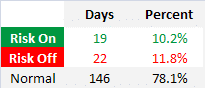
Risk On = average gain of over 1% for “risk” assets; Risk Off = average loss of over -1% for “risk” assets.
What about the overall market correlations? As a refresher, correlation is a statistical measure of how interrelated two sets of data are. A correlation of 1.00 would mean that the markets move in lock-step, and a correlation of -1.00 means that they always move in opposite directions. For diversification value, what we’re looking for is non-correlation (a correlation of 0.00), which would mean that the two markets are behaving as though they are completely unrelated.
The overall market correlation in September was nearly identical to August’s, coming in at 0.298 (based on the absolute value of all market correlations), still only slightly higher than the overall 2012 average correlation of 0.269.