
It seemed as though we were watching a rerun yesterday. Stocks tumbled amid European woes and the great Apple swung and missed, and in came the white knight to save us all – a report that the Fed was about to “act.” In true Stocktwits fashion, the snark was out in full force on the stream, with one liners ricocheting around the interwebs at the speed of light.
The not-so-subtle implication was that the Fed movement was about propping up the stock market. Not a new argument, by any stretch of the imagination. The markets have been drunk off the Fed’s hooch for some time now, but even watching the indices rebound on the leak, turning just green enough today, we had to wonder how much water this assumption actually holds. How related are upticks in quantitative easing speculation or changes to the movements of the stock market? And how durable are the subsequent moves?
Obviously, market moves don’t happen in a vacuum, but that didn’t stop our curiosity. We compared Google Trend data on the search phrase “quantitative easing” to the 12 week rolling rate of return for the S&P 500. It was, admittedly, a rough comparison, with dates never exactly matching up, but here’s what we found:
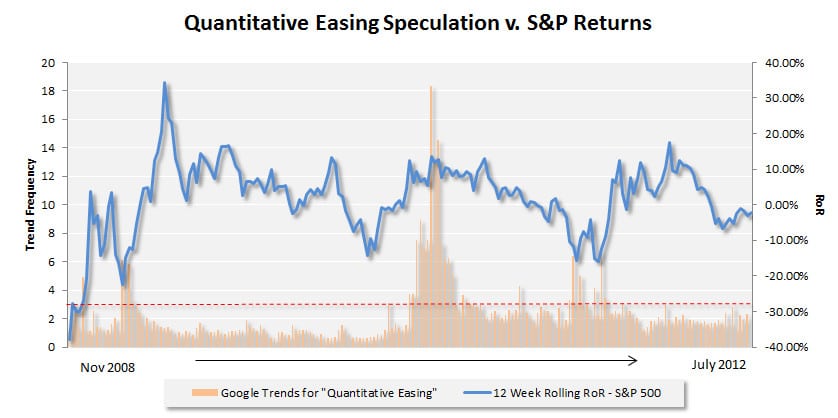
Interesting chart? Maybe, but only with context. We delved a little deeper, and isolated periods of sustained above average trending for quantitative easing, which we defined as blocks of time with less than 4 consecutive weeks of average or below average trending, and the performance of the S&P before and after. One would assume that spikes in speculation would be preceeded by substantial downtrends, and if the hullabaloo is to be believed, that they would be followed by general spikes. Not so.
The first round of QE definitely follows this story line, but since then, the narrative has changed. For instance, the decline that spanned May through July 2010 did not create a subsequent uptick in QE trending. In fact, the following uptick came well after the rebound, during a period of choppy, sideways movement. In September 2011, we saw another uptick in trending and a jump in the markets, but the gains were quickly erased until the next brief uptick in October, but as we know, there was no action associated with that uptick, which doesn’t jive with the subsequent market drive.
It’s hard to deny the short-term impact of QE speculation on market moves- we’re seeing it now. But are these changes durable? Is the link between the two as strong as we’d like to think? Not so much. And it appears as though the impact has diminished substantially since the three ring circus began, with derived bounces decreasing in both strength and duration. In our minds, it’s a reflection of the fact that the Fed is quickly running out of bullets in the midst of a rapidly deteriorating global economic outlook (see here), but with the Hilsenberg reporting still so fresh, who knows? Maybe this time is different.