
Working in finance, you learn not to talk shop too much with family members. It’s a little easier for us to avoid typically. They ask us for a stock recommendation, we say we don’t do stocks, they get a blank look on their face, and we change the subject. But seriously, talking finance with family members can be the headache from hell when you’re working in it day in and day out. Take the following conversation one of the people in our office had with their under 50 mother – a necessary one, but facepalm status nonetheless:
Daughter: Mom, when was the last time you talked to your adviser?
Mom: We’re fine.
Daughter: Mom, seriously, when was the last time you went over your portfolio?
Mom: It’s ok- we’ve got plenty of time. Everything will work out over the long term.
Daughter: You’re young, you’re right, but that doesn’t mean you shouldn’t be diligent about these things. Do you know what’s in your portfolio?
Mom: Sure, it’s fine. Seriously- we’ve got all the time in the world.
Translation: she doesn’t really know what’s in there or why, so she’s just repeating the excuse given to her by her adviser. The excuse itself bears scrutiny, though: Time. Funny word, that. Unfortunately, most of us don’t have time, but will instead be forced to work overtime in the big picture just to make ends meet during retirement. US News and World Report states:
Most Americans no longer aspire to retire early. Workers are increasingly pushing back their desired retirement age and wondering if they will be able to retire at all.
The age workers expect to retire has increased from an average of 60 in 1995 to 66 in 2011, according to a Gallup poll. The proportion of people aiming to retire early has plummeted from 50 percent in 1995 to 28 percent in 2011. Most Americans now expect to retire at age 65 or later.
“It’s just not possible for people to work for 30 or 40 years and support themselves on their assets for another 20 or 30 years,” says Alicia Munnell, director of the Center for RetirementResearch at Boston College. “Many people saw their 401(k)s decimated by the recession, and many people also saw their house lose value.”
The recession has accelerated the trend of Americans pushing back their retirement date. Almost half (46 percent) of people age 50 and older say they now plan to retire at a later age than they did three years ago, and the reason is often because the value of their 401(k) and other retirement investments has declined, according to a recent Towers Watson survey. Unsurprisingly, workers depending on their 401(k)s to finance retirement are planning longer delays than people with a traditional pension.
All that time you thought you had? Well, you may have an additional ten to twenty to wait – not out of choice, but necessity. That’s not the kind of time you want to have.
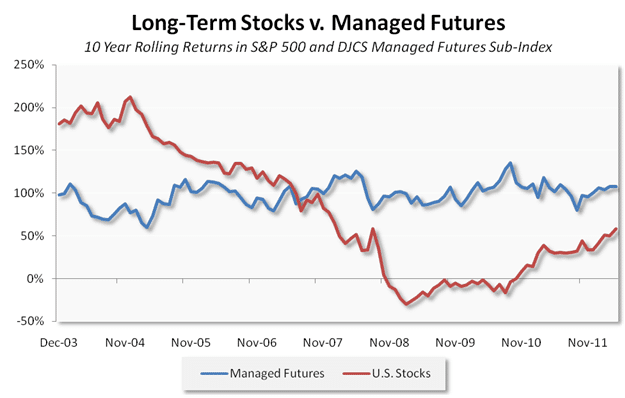
The whole concept of having a lot of time before you retire feeds into the ideas guiding your investment portfolio. When you have time, the buy and hold strategy looks pretty attractive. But how, exactly, is that working out? Well, had you started using this strategy back between 1993 and 1996, it might have been a winning strategy for you over a ten-year period. However, if you look at the chart below, you’ll notice that the ten-year rolling return for an investment in the S&P 500, used here as an imperfect proxy for stock exposure, actually dipped into negative territory for a full two-year time period.
Disclaimer: Past performance is not necessarily indicative of future results.
The more interesting thing to note, though, is the blue line – managed futures performance per the Dow Jones Credit Suisse Managed Futures Sub-Index. Assuming a world where this index were investable (it’s not), you’d notice that managed futures rolling ten year returns are actually increasing relative to the same measure for stocks. In fact, the average 10-year rolling return for managed futures was 99%, while the average for stocks was 79%. And as a gloating aside – note that the managed futures line never once dipped into negative territory the way stocks did.
To be fair, past performance is not necessarily indicative of future results, and managed futures, because of the risks involved, is never going to be right for every investor. The illustration above is not a perfect representation – it’s just a snapshot that we hope makes you think about “time” and planning a little differently. It’s not that we don’t think you should look at investing over the long-term, because we do. Managed futures investments should have a minimum timeframe of three to five years, in our opinion. What we’re saying is that even when you do look at the long term, there are still potentially better options than the traditional investments you’ve been looking at. Even if you do want to invest with longer timeframes, you can do better than a traditional buy and hold approach.
Sigh. Oh, Parents. We’ve become them, in many ways – nagging them to look at their portfolios, chasing around rugrats of our own. We’re suddenly in a position to be giving them advice – just make sure you’re listening to the advice you dole out as well.