It’s been a bumpy month or two in the markets, with reversals reminiscent of last year’s wild ride, punctuating continued fears about global growth. However, one commodity in particular has been whipsawed by the worry: cotton.
Cotton is no stranger to volatility. After surging over 92% in 2010 and plummeting over 30% in 2011, it seemed as though it was on a slow and gradual downward slope for 2012. That is, until nose-diving in May to accumulate the largest drop in prices in over two decades. Despite an uptick this month, it’s still down close to 20% on the year.
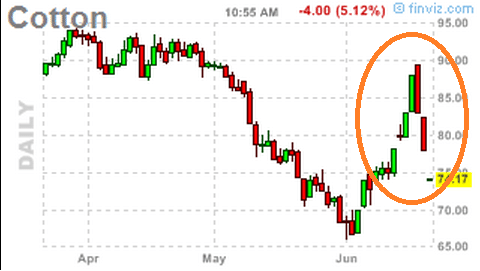
However, that being said, just look at the circled portion of this chart. Volatility in cotton has undeniably ratcheted up recently, with several limit up/limit down days piling up over the past few weeks – and an incredible four limit moves over the past five days. For those foreign to the commodity futures markets, a limit up or limit down move may seem unnerving, but for those familiar with futures trading, it’s just a part of the process. For those in the managed futures space, it’s usually even less of a concern. As we’ve written about before, these limit moves are a part of the process, and are addressed through various risk management controls. Obviously, there’s always going to be risk involved in managed futures, and a limit move could be in an unfavorable direction, but a limit up or down day probably isn’t going to result in a program blowing up.
Still, how have the moves in cotton been impacting managers? The about-face in the market at the beginning of June likely pushed several trend followers out of their positions, but some programs, like Covenant Capital and APA Strategic Diversified, remain in their short positions with open trade profits (past performance is not necessarily indicative of future results).
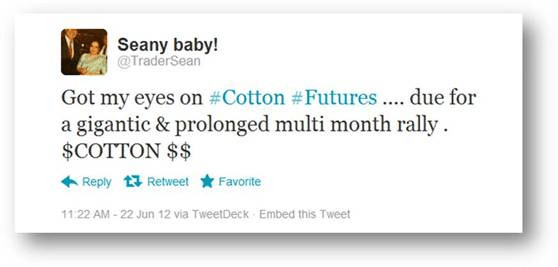
There are conflicted beliefs on what comes next in cotton, with some arguing that prices have dipped too low and others believing that it’s simply a casualty of the global downturn. But with news like this hitting the wires these days, who knows? Maybe the Twitter folks have it right (no, don’t be silly, this isn’t a trade recommendation – it’s the opinion of one person).