
We feel like we spent the bulk of the first quarter writing about how managed futures was lusting after a solid trending environment, and how bad some of the trend reversals were in 2011. How delightful to be able to change things up a little bit. Some of the trend following managers we track finally seem to be finding their groove again. Clarke Capital, for instance, has struggled through much of the past three years, with the 2009-2010 “rough patch” leading to the largest real-time drawdown since inception of the program in 1996. However, in both their Worldwide and Global Basic programs, Clarke Capital has been able to ride a winning trend in a meaningful way, profiting off of their position in soybeans in Global Basic while still maintaining the trade in Worldwide, putting the two programs up 2.28% and 1.74% month to date, and contributing to a February-to-present return of 18.38% for Global Basic and 4.58% for Worldwide. (Disclaimer: Past performance is not necessarily indicative of future results.)
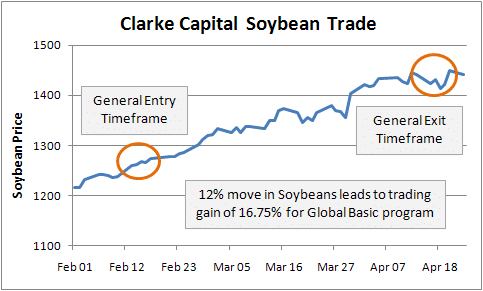
- 16.75% gain = $8,387.50 profit on trade divided by $50k minimum account. DISCLAIMER: PAST PERFORMANCE IS NOT NECESSARILY INDICATIVE OF FUTURE RESULTS.
Of course, this is only one trade among many. It makes a difference for the Clarke programs with their condensed portfolio of markets (17 for Basic, 29 for Worldwide), but a single soybean trend is doubtful to do much of anything for the biggest of the big managed futures programs who have portfolios of more than 100 markets. The big guys are going to need trends in interest rate and currency markets to make any real headway. But seeing the Soybean move is one of several developments that has us hopeful about the trading climate managers are facing today. In our experience, the average holding time for a trend following trade is around 5-10 days for losing trades and 25-50 days for winning trades. In order for trend followers to prosper, they need ample trends for them to evaluate, but more importantly, these trends need to be durable enough for them to latch on to.
In 2011, in particular, those trends were hard to come by. To see how recent conditions stack up, we examined trends in six markets in different sectors: S&P 500, Copper, US Dollar, US 30 Year Bonds, Soybeans, and Crude Oil. We define a day as “trending” if the ADX (Average Directional Movement Index) is higher this day than the previous day, and a 7/14/21/etc trend period as that number of consecutive days with the ADX higher. In looking at the percent of time these six proxy markets were in either 7, 14, or 21-day trend periods against the backdrop of the Newedge CTA index performance over the same period, we can see these longer lasting trends have started to come around again, which could help trend followers regain their mojo. (Hard to believe there were NO 21 day trends per our definition in all of 2011).
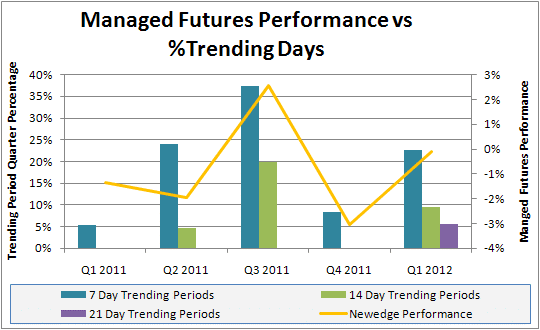
Market conditions are perpetually changing, so there’s no guarantee the increase in trendiness on a longer time frame will bear fruit for managed futures overall. And realistically, it’s not just about whether or not the trends are there – these programs’ models need to recognize and exhibit confidence in their staying power and risk dynamics before the trade is placed. For many trend followers, this process hasn’t clicked yet. For instance, the Newedge CTA Index is comprised primarily of large trend following CTAs, and according to the Barclay Hedge website, the index is currently down -0.54% month to date. But a girl can dream… right? So what will it be? Will this environment only benefit the few, or will the many climb on board the developing trends as well? We’ll have to wait and see.