
Tomorrow the US employment report (non-farm payrolls) for February will be released. Every month (usually on the first Friday of the month, but not always) the Bureau of Labor Statistics publishes these numbers, and they’re generally watched very closely. As traders, we’ve been told to fear the volatility of NFP days. Why? The idea is that this announcement moves markets when unemployment is high because there is a desire for more employment to spur the economy – with more people working there will be more consumption, higher GDP, higher taxes, etc…
On the flip side, when unemployment low, there is less desire for increased employment so that demand-pull inflation doesn’t set in ala the Phillips curve (if everyone is making good money, they’ll bid up the prices for goods and services). So, 7:00 AM CST on these Fridays is usually expected to be a volatile time for bond markets (as well as Crude and other risk on/off assets at times) – the theory being that if employment is a canary in the coal mine for problems, Fed actions will follow shortly thereafter to correct imbalances. We wanted to see how this bears out in practice…
So just how much more volatile are NFP days compared to the rest of the year? We looked at the average change in volatility on NFP days compared to the rest of the year:
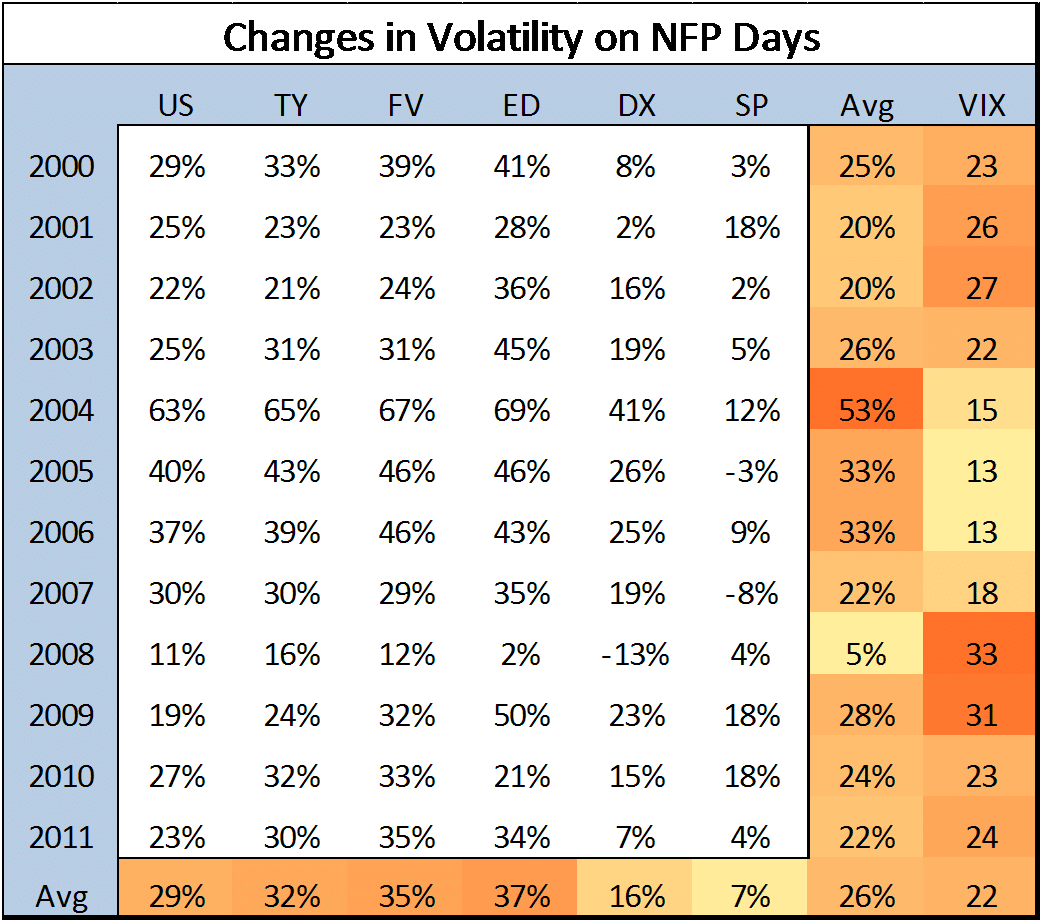
Turns out the conventional wisdom is right on the money. Volatility increases on NFP days increase by 26% on average, with the largest increase in 2004 and the smallest increase in 2008. Points of interest: NFP days appear to be more of a “shock” event in years with lower overall volatility (such as in 2004) and doesn’t shift things as much in high volatility environments (such as in 2008). Also of note – SPs are the least affected among the financial markets we looked at. We don’t have a crystal ball, and can’t say what tomorrow’s report will bring… but history suggests that our NFP day volatility worries may be well-founded.