
It’s not every year that has 366 days… it’s every fourth (except for years divisible by 100, excluding those divisible by 400). Even that system isn’t quite precise enough to keep our calendar on track, so we have leap seconds, too. (Watch out for that extra second on June 30th this year).
But do all of these calendar shenanigans have an effect on the market? One more tick of the second hand isn’t likely to change anything, but what about a whole extra 24 hours?
Well, probably not. For instance, the average daily gain for the S&P 500 on February 29th is 0.05%, compared to 0.03% for all days. Not much of a difference (in absolute terms) there.
What about Managed Futures? Here the numbers look a little odd:
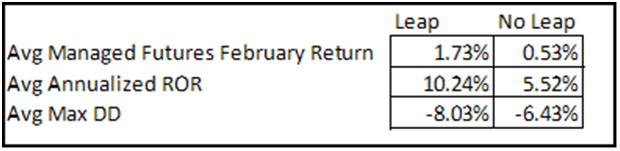
Triple the returns for leap February compared to common February? What’s going on?
While this certainly looks interesting, it’s almost certainly a statistical fluke. Going back to ‘94 only gives us 4 leap years to look at (’96, ’00, ’04, ’08). One of those years (’08) happened to be one of the best years for Managed performance. More importantly, none of the other years happened to be losing years (the biggest losers being ’95, ’99, ’09, and ’11). As a result, the outlier year in ’08 is skewing the average up and disguising the fact that two non-leap years (’98 and ’02) had even better returns than ’08.
This brings up a valuable lesson that can’t be repeated often enough – correlation does not equal causation. And while we’re at it, don’t take every statistic you see at face value. Because not everything the produces an interesting result is necessarily meaningful.
Happy Leap Day!