
When CTAs evaluate the markets, they’re looking for different things, depending on their strategy. That being said, especially in the trend following space, managers will often select markets in order to diversify their program and hedge against all of their positions losing money in one fell swoop. Of course, futures trading is complex, and there is always a risk of loss, but these market selection tactics help CTAs better manage risk within a program.
2011 made that difficult, as we outlined in our 2012 outlook. After seeing higher than usual market correlations and a major surge in risk on/risk off trading, CTAs were hoping that 2012 would give them a trading atmosphere better suited for market diversification. How’s that working out?
Let’s first take a look at the 2011 managed futures performance scapegoat – the risk on/risk off trading environment. We broke down the risk on/risk off trade earlier this year, when we looked for the average daily move of the “risk on” market grouping between 2000 and 2011 and defined a day as “risk on” when the average gain across all of those markets was over 1%. While 1% may seem somewhat small to be a full bore “risk on” day, that is the average across all those markets, and we found it to be best aligned with the reporting of risk on/risk off days in both the mainstream media and our own commentary. A “risk off” day was the inverse – a day where the risk on market grouping was down over 1%. Using these metrics, 2012 looks far more normal than 2011 did.
| Year | “Risk On Days” | “Risk Off Days” | “Normal” |
| 2011 | 10% | 11% | 79% |
| 2012 | 9% | 6% | 85% |
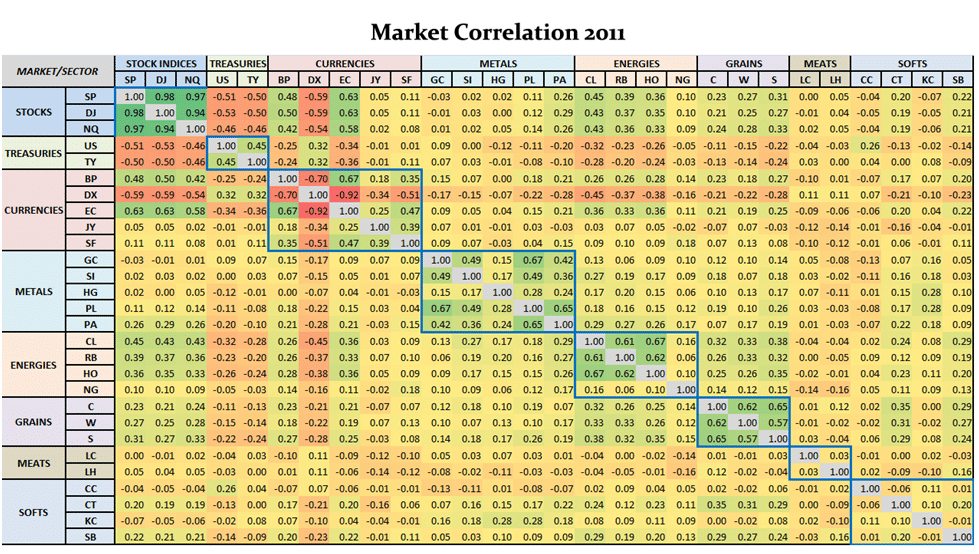
While that’s definitely what we like to see, what about market correlations? As a refresher, correlation is a statistical figure with values which range between -1.00 and +1.00, meant to show how inter-related two sets of data are (in the case of investments, we are usually looking at the monthly percentage returns). If they have a correlation of 1.00, they are perfectly correlated, meaning when one market rises 3%, the other will do the exact same, and when one loses -2%, so will the other. If they are at -1.00, they are exactly opposite; with one making the exact opposite amount the other loses each month, and vice versa. In 2011, these relationships were much stronger than they usually are:
And 2012? Unfortunately, it seems as though market correlation levels from 2011 are persisting in the new year, though there are a handful of exceptions:
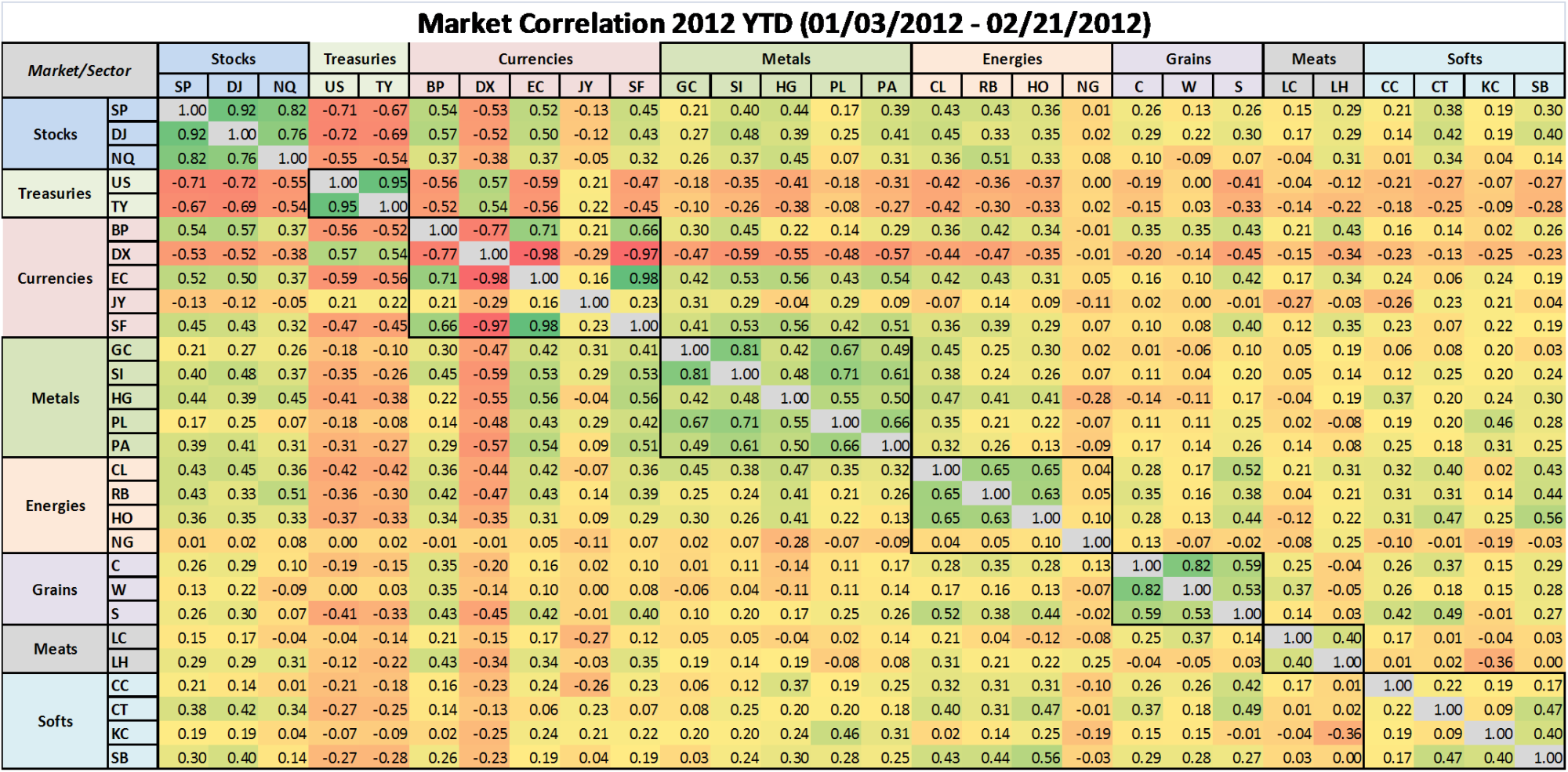
In other words, while the risk on/risk off trade may be subsiding, the markets are still seeing higher correlation levels than what many managers may prefer. But which matters more? Year to date, managed futures, according to the Newedge CTA index* today, is up .91% (Disclaimer: Past performance is not necessarily indicative of future results). Whether that’s a matter of risk on/risk off trading falling to the wayside or individual trades making it happen for managers in the index, only time will tell. In the meantime, we’ll be keeping an eye on market trends and how they’re impacting CTA performance. Stay tuned.