
We’ve been keeping an eye on the Baltic Dry Index (BDI). By keeping an eye on it, we mean watching it plummet faster than Kim Kardashian’s heart after getting turned down by Tebow. Exaggeration? Nope:
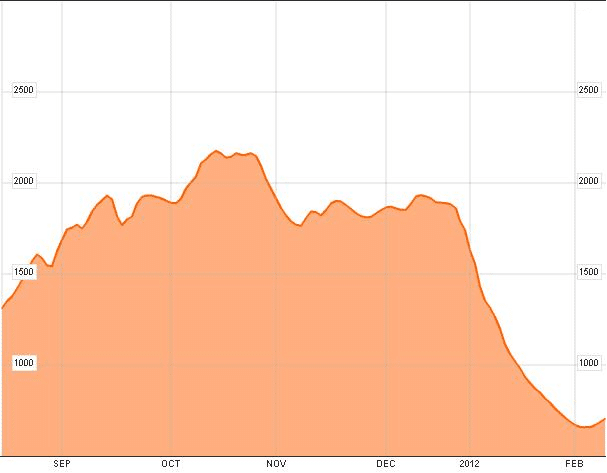
So far in the New Year, the Baltic Dry Index (BDI), which tracks shipping rates across key routes, has undergone a free fall, hitting a nearly 20-year low, even below the mark that was witnessed during the worst of the post-Lehman crisis in 2008. Shipping companies fear that the fall may take some more time to be arrested, as shippers globally adopt a wait-and-watch policy before going in for fresh bookings… the BDI plumbed to below 600 levels, touching the lowest of 651 on February 2, below the 663 mark that the index had touched during the post-Lehman crisis in December 2008.
According to the spot rates that some of the Indian shipping companies booked, the BDI retreated from an average 2,071 in October 2011 to 1,869 in December and below the 1,000 mark after January 2012. Towards January-end and February beginning, the index hit below 700. In November and December 2008, the index had averaged 819 and 743 respectively, when the world economy was plunged into a crisis.
Why does it matter? Well there is a theory that the Baltic Dry Index is a leading indicator for commodity demand, with it tracking the price shippers charge for shipping raw goods by sea. The theory is that this serves as an indicator of demand for the goods in question. If demand is high, demand for shipping will be high, ultimately pushing the index higher – which will eventually show up in higher commodity prices. High index levels (again, theoretically) should correspond with higher commodity prices, while low index levels would indicate the reverse.
Theoretically.
Why all the caveats?
Well, during the economic mess of 2008-2009, the BDI appeared to be a bellwether for commodity prices. In June 2008 (a month before the world started to unwind) the BDI plunged more than -16%, preceding the next month’s -12% drop in commodity prices (as measured by the S&P Goldman Sachs Commodity Index, the GSCI). In fact, the correlation between the BDI (with a 1 month lead) and the GSCI was a rather robust 0.84 between June 2008 and March 2009. However, it hasn’t been clear whether the BDI has remained a strong indicator for commodity prices. Never satisfied with idle banter, we decided to go to the data, calculating correlation levels based on monthly changes of the BDI and the GSCI. Here is what we found:
| Correlation | BDI 1mo lead | BDI 1mo lag | |
| 2000-Present | 0.218 | 0.117 | 0.136 |
| 2000-2008 | 0.113 | -0.151 | 0.154 |
| 2008-Present | 0.283 | 0.274 | 0.143 |
Turns out, that robust correlation during the financial crisis was just a temporary phenomenon (something about everything correlating during a big downturn?) From a longer-term perspective, those correlations appear to be nothing more than noise. And introducing a 1-month lead or lag doesn’t produce any startling changes, either. One reason this connection isn’t as strong as it is portrayed at times is that the supply of shipping – one of the main factors in shipping prices – is not strictly tied to the demand for what they are shipping. There has been a massive boom in ship deliveries since the good times circa 2007 (ships take a long time to build, and plans laid in the good times are even just now coming to market/sea) and this drives down shipping prices.
Still, the Baltic Index down over 60% on the year may be making some long only commodity investors nervous, and we may see the GSCI fall back substantially from its 5% gains year to date. It’s just that the fall in the Baltic index doesn’t mean we absolutely will see a similar drop elsewhere. No matter how it plays out, the nice thing about managed futures is that they don’t need the markets to go in a specific direction to make or lose money- we’ll take a trend in either direction.