
We always enjoy when Barry Ritholtz, one of our favorite market/economy bloggers, puts out his collection of market sentiment charts, as he did last week. Our favorite is the simplistic one below with the cute faces.
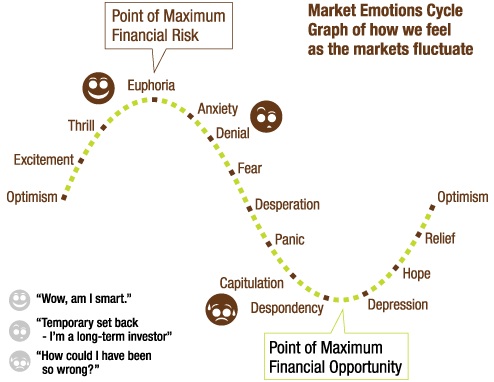
We actually put numbers to this chart in a newsletter a while back, showing how getting in at the highs and out at the lows (those points of emotional distinction) might look like if the model were applied to a trading system. The trick was defining what euphoria and despondency looked like in terms of performance numbers, and we came up with a simple way of defining what each of the emotional stages represented in terms of actual numbers by assigning each stage a corresponding new multi month high or low reading. For example, Euphoria is represented by a new 21 month high, hope by a new 3 month high, and so on.
Barry’s posting of these charts again got us thinking as to how the stock market performs, on average, on the market emotions cycle. Mainly, we wanted to see if the Euphoria stage actually is the point of maximum financial risk, and conversely whether the Despondency stage really is the point of maximum financial opportunity. We found that to generally be the case, with Euphoria (as represented by a new 21month high in the S&P 500) followed by below average returns over the following 12 months, and Despondency (as represented by a new 21 month low in the S&P 500) followed by above average (well above average) returns over the following 12 months.
Anyway, some food for thought, and support that it is never a good thing to be getting in at the highs and out at the lows.

For those of you who like tabular format better:
